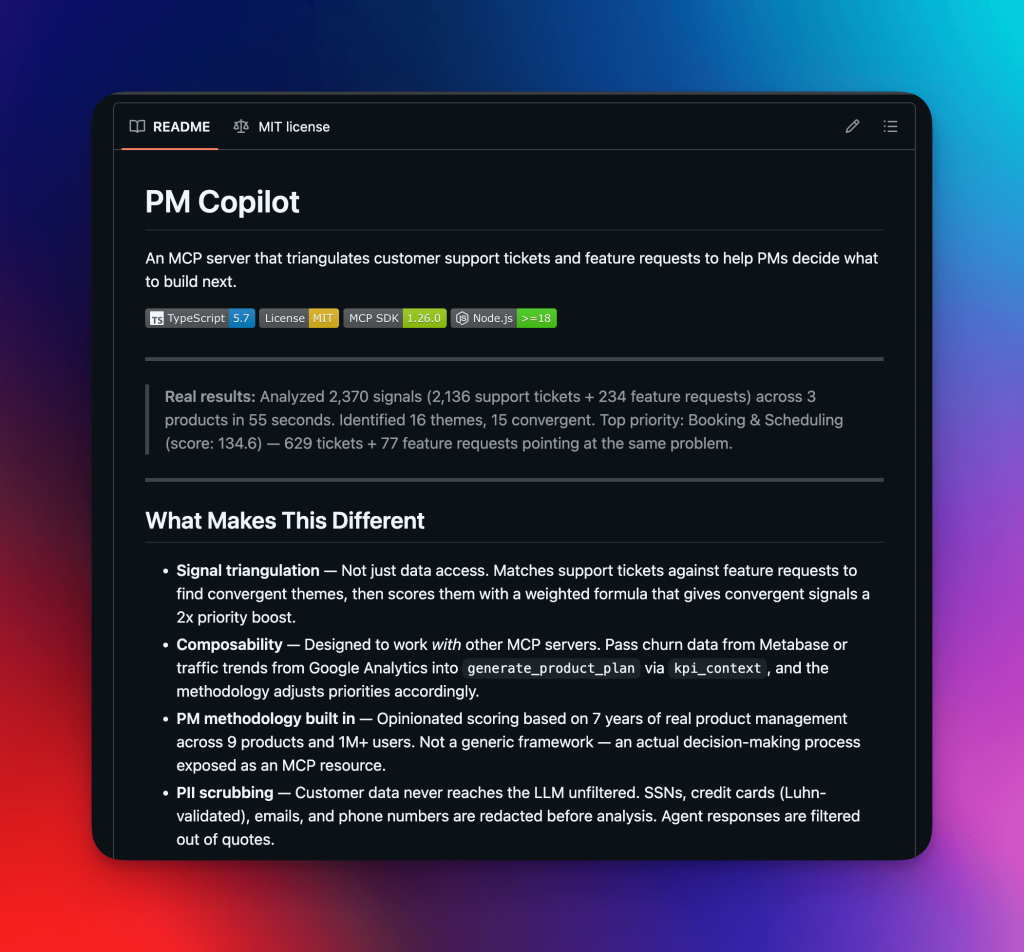

PM Copilot
About
Triangulates customer support tickets and feature requests to generate prioritized product plans with convergence scoring and PII scrubbing.
Details
- Author
- dkships
- GitHub stars
- 27
- Downloads
- 336
- Categories
- Productivity, Other, Project Management
Jump to
- Reactive > proactive. Broken stuff drives churn. You can survive not having a feature; you can't survive errors
- Business metrics override the formula. Rising churn, dropping conversion, or revenue impact can change everything
- preview_only: true on generate_product_plan shows what data would be sent without fetching it
- Every response includes pii_scrubbing_applied and pii_categories_redacted metadata
- Data categories logged to stderr on each call (categories only, never content)
Follow the repository README to install the server and add its MCP configuration to your client.
An MCP server that triangulates customer support tickets, feature requests, and AI support agent conversations to help PMs decide what to build next.
Real results:Analyzed 3,353 signals in one 30-day window — 1,678 support tickets, 276 feature requests, and 1,399 AI support agent conversations across 4 products. Top priority: Booking & Scheduling — 285 tickets + 74 feature requests + 347 chats pointing at the same problem, with the AI agent answering with low confidence in 48% of those chats.
The 1,399 chats are the point. None of them were visible to the analysis before v1.4.0, and they are 83% the volume of the ticket channel.
Read the full story:I built an MCP server that changed how I prioritize products— why I built this, how convergent signals work in practice, and what I learned building with Claude Code.
- Signal triangulation.Matches support tickets against feature requests to find convergent themes, then scores them with a weighted formula that gives convergent signals a 2x priority boost.
- The deflection blind spot.An AI support agent answers questions that never become tickets, so ticket-based prioritization undercounts every theme the bot handles — and the gap widens as the bot improves. Chatbase conversations are pulled in as a third signal class, with a per-themeself_serve_failure_rateshowing where self-serve is failing.
- Composability.Works alongside other MCP servers. Pass churn data from Metabase or traffic trends from Google Analytics intogenerate_product_planviakpi_context, and the methodology adjusts priorities accordingly.
- Built-in PM methodology.Opinionated scoring based on 7 years of product management across 9 products and 1M+ users. It's a real decision-making process exposed as an MCP resource, not a generic framework.
- PII scrubbing.Customer data never reaches the LLM unfiltered. SSNs, credit cards (Luhn-validated), emails, and phone numbers are redacted before analysis. Agent responses are filtered out of quotes.
graph TD A[Claude Desktop / Code] -->|stdio| B[pm-copilot] A -->|stdio| C[Metabase MCP] A -->|stdio| D[Google Analytics MCP] B -->|Reactive| E[HelpScout: tickets] B -->|Proactive| F[ProductLift: feature requests] B -->|Deflected| I[Chatbase: AI agent chats] C -->|Quantitative| G[Conversion, Churn, Revenue] D -->|Acquisition| H[Traffic, Channels, Trends] B -.->|kpi_context| A
Claude orchestrates multiple MCP servers. PM Copilot handles qualitative customer signals. Other servers provide quantitative business metrics. Thekpi_contextparameter is the integration point — no point-to-point integrations required.
git clone https://github.com/dkships/pm-copilot.git cd pm-copilot npm install cp .env.example .env # Edit with your credentials npm run build
HelpScout is required. ProductLift and Chatbase are both optional — configure either, both, or neither, and the analysis adapts.
Chatbase API access needs a Chatbase Standard plan or higher. On a lower plan the API returns 403 and the deflection signal is reported as a warning rather than failing the whole analysis. One agent per product is the useful shape — agents give you product-level attribution that a shared support mailbox does not.
Add to~/Library/Application Support/Claude/claude_desktop_config.json:
{ "mcpServers": { "pm-copilot": { "command": "node", "args": ["/absolute/path/to/pm-copilot/dist/index.js"] } } }
claude mcp add pm-copilot -- node /absolute/path/to/pm-copilot/dist/index.js
Or use the.mcp.jsonalready in the project root — Claude Code picks it up automatically.
Cross-references HelpScout tickets, ProductLift feature requests, and Chatbase conversations, returns theme-matched analysis with priority scores.
Returns themes sorted by priority score, each with reactive/proactive counts, convergence flag, evidence summaries, and representative customer quotes.
Builds a prioritized product plan with evidence and customer quotes. Accepts external business metrics viakpi_context.
Raw ProductLift data access for browsing feature requests directly. Each request includes its publicurl.
Lists the data sources the server is connected to — HelpScout mailboxes (id + name), ProductLift portals (name + url), and Chatbase agents (name + id) — so you can discover the names to pass tomailbox_name/portal_name/agent_name. When Chatbase is configured it also returnschatbase_conversation_sources, the valuessource_filteraccepts (a fixed list from the Chatbase docs, not queried per account). Read-only; never returns API keys or customer data. Takes no parameters.
Three sources, three different things they tell you. Only the first two feed the convergence rule.
Deflected signals count toward frequency and carry two evidence fields per theme, but they do not enter the severity or vote-momentum terms and do not change the 2x convergence boost. The formula is unchanged from v2.1:
- deflected_count— conversations matching the theme
- self_serve_failure_rate— share of those conversations where the agent's lowest answer confidence fell below 0.5
- mean_answer_confidence— mean of that same score
A theme with highdeflected_countand a highself_serve_failure_rateis one customers keep asking about that self-serve does not resolve. Chatbase does not document what itsmin_scorefield measures, so it is reported as evidence for the LLM to weigh rather than folded into the priority score.
Conversations arrive from several channels (widget, WhatsApp, Messenger, API, …). The analysis reports achatbase_sourcescount per channel, and thesource_filterparameter narrows a run to one or more channels (comma-separated) — the filter is applied server-side by Chatbase. One catch: counts can include channels the filter list does not cover, likePlaygroundorunknown(Chatbase omitted the source). A filter value outside the known list is passed through with a warning rather than rejected, since zero matches usually means the value is wrong, not that the channel went quiet.
Chatbase is optional. With noCHATBASE_API_KEYset, the deflection fields are simply absent and the analysis behaves exactly as before.
A trimmedsynthesize_feedbackresponse at the defaultsummarydetail level. Values are illustrative; note the PII scrubbing applied to the customer quote.
{ "timeframe_days": 30, "detail_level": "summary", "portal_name": "all", "fetched_at": "2026-06-01T16:00:00.000Z", "pii_scrubbing_applied": true, "pii_categories_redacted": ["email", "phone", "credit_card"], "analysis": { "total_data_points": 612, "reactive_count": 548, "proactive_count": 64, "deflected_count": 312, "chatbase_sources": { "Widget or Iframe": 284, "WhatsApp": 23, "API": 5 }, "themes": [ { "theme_id": "booking-scheduling", "label": "Booking & Scheduling", "category": "core", "priority_score": 87.1, "convergent": true, "signal_type": "convergent", "reactive_count": 211, "proactive_count": 19, "deflected_count": 96, "self_serve_failure_rate": 0.48, "mean_answer_confidence": 0.53, "evidence_summary": "326 signals (211 support tickets, 19 feature requests, 96 AI chat conversations). Convergent — appears in both support and feature requests (2x priority boost). The AI agent answered with low confidence in 48% of those chats — customers ask about this and self-serve often does not resolve it.", "representative_quotes": [ "[Support ticket] \"Double-booked slots again after the timezone change — reach me at [EMAIL REDACTED]\"", "[Feature request, 47 votes] \"Let me block buffer time between meetings\"", "[AI chat, answer confidence 0.31] \"how do i stop people booking on weekends\"" ] }, { "theme_id": "list-management", "label": "List & Contact Management", "category": "audience", "priority_score": 41.7, "convergent": false, "signal_type": "deflected", "reactive_count": 0, "proactive_count": 0, "deflected_count": 58, "self_serve_failure_rate": 0.58, "mean_answer_confidence": 0.5, "evidence_summary": "58 signals (58 AI chat conversations). The AI agent answered with low confidence in 58% of those chats — customers ask about this and self-serve often does not resolve it.", "representative_quotes": [ "[AI chat, answer confidence 0.22] \"how many contacts does pro allow\"" ] } ], "emerging_themes": [ { "pattern": "csv export", "frequency": 12 } ], "unmatched_count": 38 } }
PM Copilot is designed to work alongside other MCP servers. Here's a worked example showing how akpi_contextoverride changes the ranking. Numbers are illustrative.
Pull our churn and booking completion data, then use pm-copilot to create a product plan using all of that context.
Step 2: pm-copilot analyzes the signals and returns the top priorities
Step 3: Business metrics from dashboards arrive askpi_context
Product A: booking completion rate dropped from 74% to 66% over last 30 days. Monthly churn increased from 3.1% to 4.2%. Organic traffic up 22% MoM. Product B: document completion rate steady at 81%. Churn flat at 2.8%.
Step 4: Claude synthesizes both, and overrides the formula
The scores say Billing & Payment is #1. But the methodology sayschurn data overrides the formula. With Product A's booking completion dropping 8 points and churn spiking 35%,Booking & Scheduling becomes the real #1— it's the core product breaking.
Product B deprioritized (stable metrics, no fire). Product A's 22% organic traffic growth elevates Whitelabel & Branding as a growth play.
The server provides the signal ranking. KPI context provides the override judgment. Claude synthesizes both.
PM Copilot exposes apm-copilot://methodologyresource — David Kelly's product planning framework, built over 7 years of launching 9 products to 1M+ users.
- The 5% rule.You complete about 5% of what customers ask for each month. The framework identifies which 5% matters most.
- Convergent signals always win.The same theme in both support tickets and feature requests is the highest-confidence signal.
- Reactive > proactive.Broken stuff drives churn. You can survive not having a feature; you can't survive errors.
- Business metrics override the formula.Rising churn, dropping conversion, or revenue impact can change everything.
The methodology is versioned (v2.1) and served as markdown content via the MCP resource protocol. Everygenerate_product_planresponse links to it (methodology_resource) and, whenkpi_contextis provided, instructs Claude to apply it — whether it actually gets read depends on the MCP client surfacing resources.
The scoring formula only matters if the theme matching underneath it is right.npm run evalmeasures that.
Themes are matched with keyword lists — multi-word keywords as substrings, single words on a word boundary with an optional regular plural suffix — not embeddings or an LLM classifier. That is a deliberate trade-off:
- Customer text never leaves the server for a third-party embedding or classification API. The PII guarantees below only hold because nothing in the matching path makes a network call.
- The same input always produces the same themes, so a priority ranking can be audited and explained. An LLM classifier would reshuffle rankings between runs.
- No token cost or latency per data point, which is what makes a 2,000-signal analysis finish in under a minute.
The cost is recall. Keyword lists miss paraphrases, and they miss them unevenly across products. On held-out live chat data a third of conversations still match no theme. That is what the eval exists to quantify, and why the number is published rather than hidden.
npm run build && npm run eval npm run eval -- --failures # every miss and false positive npm run eval -- --json # machine-readable report npm run eval -- --min-f1 0.90 # non-zero exit below threshold, for CI
Matching is multi-label — one signal can belong to several themes — so the report gives per-theme precision, recall and F1, plus two rates that matter more than the averages:miss rate(expected a theme, matched nothing at all) andfalse alarm rate(expected nothing, matched something).
The eval's first job was auditing the v2 config, and it found five real defects:
- Plural coverage was inconsistent.tierwas listed withouttiers, and single-word keywords matched on a bare word boundary, so "the tiers" matched nothing. On live chat data this was the expensive one — a recurring widget prompt, "what are your plans and prices?", matched no theme at all, becauseplanmisses "plans" andpricingmisses "prices".
- teamfired on "founding team" and "IT team" — half the false positives in the fixture.
- plantagged "i plan to launch next week" as Account & Licensing.
- upgradesat in both Billing & Payment and Account & Licensing, so an API ticket mentioning an upgrade landed in both.
- Multi-word keywords are exact substrings, socant loginmissed "cant log in" andoutlook calendarmissed "does this work with outlook".
All five are fixed in v3: single-word keywords now match an optional regular plural suffix, over-generic keywords were scoped (team→my team/team member/teams), duplicated keywords were assigned to one theme, and the missing variants were added. Two new themes came out of real unmatched conversations — Giveaways & Contests and List & Contact Management — which the config had no vocabulary for at all.
Two numbers, because they measure different things.
Against the committed fixture (82 hand-labelled examples):
Treat that with suspicion.The config was iterated against this fixture, so the v3 figure is in-sample and flatters itself. It is a regression gate — it tells you a change broke something, not how well matching works.
The number that means something is held-out real data. 1,100 chat conversations across four products, from a 30-day windowbeforethe one the new themes were derived from:
The gains land where the theory said they would: the products whose vocabulary the config never covered. A third of conversations still match nothing, so there is plenty left.
Register turned out to matter less than product coverage. Product A chat isbettermatched than tickets are, so chat phrasing on its own is not the problem — missing product vocabulary is, and per-product chat agents expose that where a shared support mailbox averages it away.
- Canned widget prompts inflate counts.Preset buttons like "I entered a giveaway — how do I know if I won?" recur verbatim dozens of times. They are not deduplicated, and that is deliberate: twenty people clicking a preset is twenty people with that question. It does mean volume for a theme with a popular preset is not comparable to volume for one without.
- Matching is English-only.Live data includes German, Spanish and Italian conversations, and all of them land inunmatched.
- Irregular plurals still need listing.The suffix rule coversplan/plans, notentry/entries.
For a number from your own data, export signals to a local JSONL in the fixture's shape and pass--fixture ./local/real.jsonl. Real fixtures contain customer text — keep them out of git.
Customer data flows through PM Copilot on its way to Claude. All text is scrubbed before it enters the analysis pipeline or leaves the server.
A chat widget takes unbounded free text, so it is the widest PII surface of the three sources — people paste order numbers, addresses and licence keys into a chat box in a way they do not into a roadmap post. This is not hypothetical: on a live 30-day run, adding the Chatbase source was what first madecredit_cardappear inpii_categories_redacted. Tickets and roadmap posts over the same window produced only emails and phone numbers.
Two things keep it contained: onlyrole: "user"turns are read, and every turn goes through the same scrubber as the other sources before it enters the analysis.
Chatbase message attribution is structured, which makes it the cleanest customer-voice source of the three. The HelpScout path has to guess at agent text with phrase heuristics because a conversation preview may be either side of the exchange; hererolesays so outright, so the heuristics are skipped.
- preview_only: trueongenerate_product_planshows what datawouldbe sent without fetching it
- Every response includespii_scrubbing_appliedandpii_categories_redactedmetadata
- Data categories logged to stderr on each call (categories only, never content)
npm install # Install dependencies npm run build # Compile TypeScript npm run dev # Watch mode npm start # Run the server npm test # Run the test suite npm run eval # Theme-matching eval (see Evaluation)
Call a tool in isolation without restarting your MCP client — useful for iterating on changes and for checking response sizes:
npm run build npm run tool -- --list npm run tool -- list_sources '{}' npm run tool -- get_feature_requests '{"portal_name":"<your-portal>","status":"open"}'
The runner prints the byte size of each response. Output may include your configured source names/URLs (and PII-scrubbed customer text) — redact before sharing.
themes.config.jsonin the project root defines what themes to look for. Edit without rebuilding — loaded at runtime.
Ships with 18 data-driven themes across 12 categories. Add your own by appending to thethemesarray. Unmatched data points are analyzed for emerging patterns using bigram/trigram frequency detection.
After editing, runnpm run eval— it reports precision and recall per theme and flags keywords that fire on another theme's examples, which is how the over-generic ones get caught.
priority = (frequency × 0.35 + severity × 0.35 + vote_momentum × 0.30) × convergence_boost
- Frequency(0.35): Count of data points, normalized across themes — includes deflected signals
- Severity(0.35): Reactive signals only — thread count (total, including agent replies), recency (7-day half-life decay), tag boosts
- Vote momentum(0.30): Proactive signals only — 80% votes + 20% comments
- Convergence(2x): Applied when a theme has both reactive and proactive signals. Deflected signals do not trigger it
Frequency and vote momentum are normalized against the top theme in the same call, so scores are relative to one analysis window. Compare rankings across calls, not raw scores.
- Changes aren't taking effect.The MCP client runs the compileddist/. After editing source, runnpm run buildand restart the client (or the MCP server connection) to pick up new code.
- No HelpScout mailbox named "…".Runlist_sourcesto see the exact mailbox names, or pass the numericmailbox_iddirectly.
- No portal found with name "…"/ portal missing.The portal must be configured inPRODUCTLIFT_PORTALS(or the single-portal env vars). Runlist_sourcesto see configured portals.
- Chatbase warning:A Standard plan or higher is required.API access starts at the Chatbase Standard plan. The rest of the analysis still runs; only the deflection fields are missing.
- chatbase_agentsis empty inlist_sources.BothCHATBASE_API_KEYand one ofCHATBASE_AGENTS/CHATBASE_AGENT_IDhave to be set — a key on its own configures nothing.
- Fork the repository
- Create a feature branch (git checkout -b feature/your-feature)
- Ensurenpm run buildsucceeds with no errors
- Follow existing patterns: tools useregisterTool, API clients get their own module, PII scrubbing happens at the format layer
- Open a pull request
Generates interactive sprint analytics and executive dashboards by connecting Jira data to Claude AI. Provides insights on burndown, velocity, and goal progress.
Get clear, reliable and actionable Customer Insights with AI.
Great Question is an Agentic UX research platform for product builders. Its MCP lets AI agents create studies directly from any AI tool, surface insights, find the right research candidates, and query your entire research repository.
An MCP server for ActivityWatch, allowing interaction with your personal time tracking data.
Critical Path Partners forensic scheduling MCP
13 tools for Primavera P6 forensic delay analysis — AACE windows (29R-03 MIP 3.3), DCMA-14 health checks, Monte Carlo SRA with AACE 122R-22 QRAMM maturity, TIA fragnet (MIP 3.7), collapsed as-built (MIP 3.8), and claim workbench evidence ledger. Open-source CPM engine (MIT) at github.com/danafitkowski/cpp-cpm-engine. Daubert-disclosed methodology. 66-jurisdiction holiday calendars. SHA-256 topology hash on every output.
Sign in to leave a review
Use Google, GitHub, or an email account so ratings stay tied to real people.
No reviews posted yet.