Building a Remote MCP Server on Cloudflare (Without Auth)
About
This is a template for deploying a remote MCP server on Cloudflare Workers that does not require authentication. It allows users to add custom tools and connect clients such as Cloudflare AI Playground or local MCP clients via an SSE endpoint.
Details
- Author
- simonberner
- Downloads
- 191
- Categories
- Developer Tools
Jump to
- Deploy without authentication on Cloudflare Workers.
- Server uses SSE transport at <account>.workers.dev/sse.
- Tools defined with zod schemas inside init() method.
- Connect directly from Cloudflare AI Playground.
- Use mcp-remote proxy to connect from local stdio clients.
- One‑click deployment via Workers button.
Deploy by clicking the "Deploy to Workers" button or running npm create cloudflare@latest -- my-mcp-server --template=cloudflare/ai/demos/remote-mcp-authless. Customize tools by editing src/index.ts using this.server.tool(...). Connect to the server from Cloudflare AI Playground or configure a local client using the mcp-remote proxy.
Building a Remote MCP Server on Cloudflare (Without Auth)
This example allows you to deploy a remote MCP server that doesn't require authentication on Cloudflare Workers.
Get started:
This will deploy your MCP server to a URL like: remote-mcp-server-authless.<your-account>.workers.dev/sse
Alternatively, you can use the command line below to get the remote MCP Server created on your local machine:
npm create cloudflare@latest -- my-mcp-server --template=cloudflare/ai/demos/remote-mcp-authless
Customizing your MCP Server
To add your own tools to the MCP server, define each tool inside the init() method of src/index.ts using this.server.tool(...).
Connect to Cloudflare AI Playground
You can connect to your MCP server from the Cloudflare AI Playground, which is a remote MCP client:
1. Go to https://playground.ai.cloudflare.com/
2. Enter your deployed MCP server URL (remote-mcp-server-authless.<your-account>.workers.dev/sse)
3. You can now use your MCP tools directly from the playground!
Connect your local MCP client to this remote MCP server
To use this remote MCP server with your local MCP client, add this configuration:
{
  "mcpServers": {
    "mcp-ts-demo-cf": {
      "command": "npx",
      "args": [
        "-y",
        "mcp-remote",
        "https://mcp-ts-demo-cf.sibebzh.workers.dev/sse"
      ],
      "disabled": false
    }
  }
}
(You can also connect to this remote MCP server from local MCP clients which only support local MCP servers via stdio, by using the mcp-remote proxy.)
Example
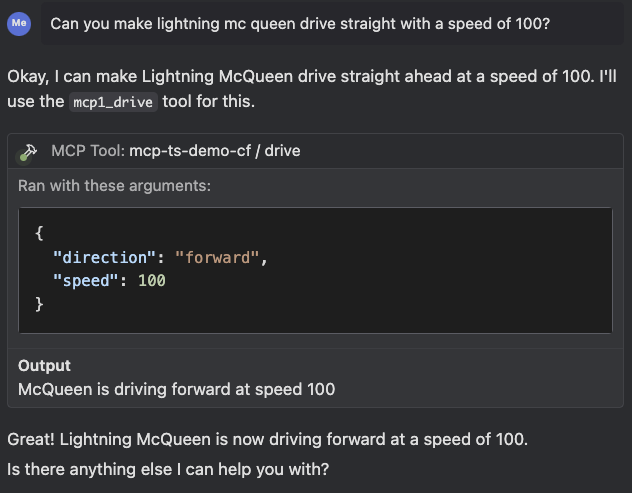
If all goes well, you should see the tools become available in your local MCP client and be able to do something like this:
Nice to know
- zod is used to define the schema for the arguments of the MCPServer tools.
Sign in to leave a review
Use Google, GitHub, or an email account so ratings stay tied to real people.
No reviews posted yet.