Mcp Rubber Duck
About
An MCP server that acts as a bridge to query multiple OpenAI-compatible LLMs with MCP tool access. Just like rubber duck debugging, explain your problems to various AI "ducks" who can actually research and get different perspectives!
Details
- Author
- nesquikm
- GitHub stars
- 171
- Downloads
- 634
- Categories
- Developer Tools, AI
Jump to
- Universal OpenAI API compatibility for any endpoint.
- CLI coding agent support (Claude Code, Codex, Gemini CLI, etc.).
- Multiple ducks queried simultaneously (Duck Council).
- Consensus voting, LLM-as-judge, and iterative refinement.
- Structured debates (Oxford, Socratic, adversarial).
- 8 reusable MCP prompt templates for multi-LLM workflows.
- Automatic failover, health monitoring, and usage tracking.
- MCP Bridge to connect ducks to other MCP servers.
- Pluggable guardrails (rate limiting, token limits, PII redaction).
- Interactive UIs for compare, vote, debate, and usage tools.

Setting up with Highlight
This MCP is not yet compatible with Highlight’s one-click setup. However, you can still use it with Highlight by following these steps:
- Download and install Highlight from highlightai.com/download
- Navigate to the plugins tab and select "Add Custom Plugin"
-
Configure the plugin with the settings below
Plugin Name
Mcp Rubber DuckCommand (node, npx, python, etc.)Please refer to the README for specific instructions on how to obtain API keys or other required environment variables.
- Enable "Start Automatically" if you want the plugin to start when Highlight launches





From the repository
Install globally via npm install -g mcp-rubber-duck or use npx directly. Configure API keys in a .env file or config/config.json. Invoke by running the server and using the provided tools (e.g., ask_duck, compare_ducks, duck_debate) from an MCP client. For Claude Desktop, see the dedicated setup guide.
Claude Desktop / Cursor
Paste into your MCP client config file to install this server.
{
    "mcpServers": {
        "mcp rubber duck": {
            "rubber-duck": {
                "command": "mcp-rubber-duck",
                "env": {
                    "MCP_SERVER": "true",
                    "OPENAI_API_KEY": "<YOUR_OPENAI_KEY>",
                    "GEMINI_API_KEY": "<YOUR_GEMINI_KEY>",
                    "DEFAULT_PROVIDER": "openai"
                }
            }
        }
    }
}McpServers
{
    "rubber-duck": {
        "command": "mcp-rubber-duck",
        "env": {
            "MCP_SERVER": "true",
            "OPENAI_API_KEY": "<YOUR_OPENAI_KEY>",
            "GEMINI_API_KEY": "<YOUR_GEMINI_KEY>",
            "DEFAULT_PROVIDER": "openai"
        }
    }
}
MCP Rubber Duck
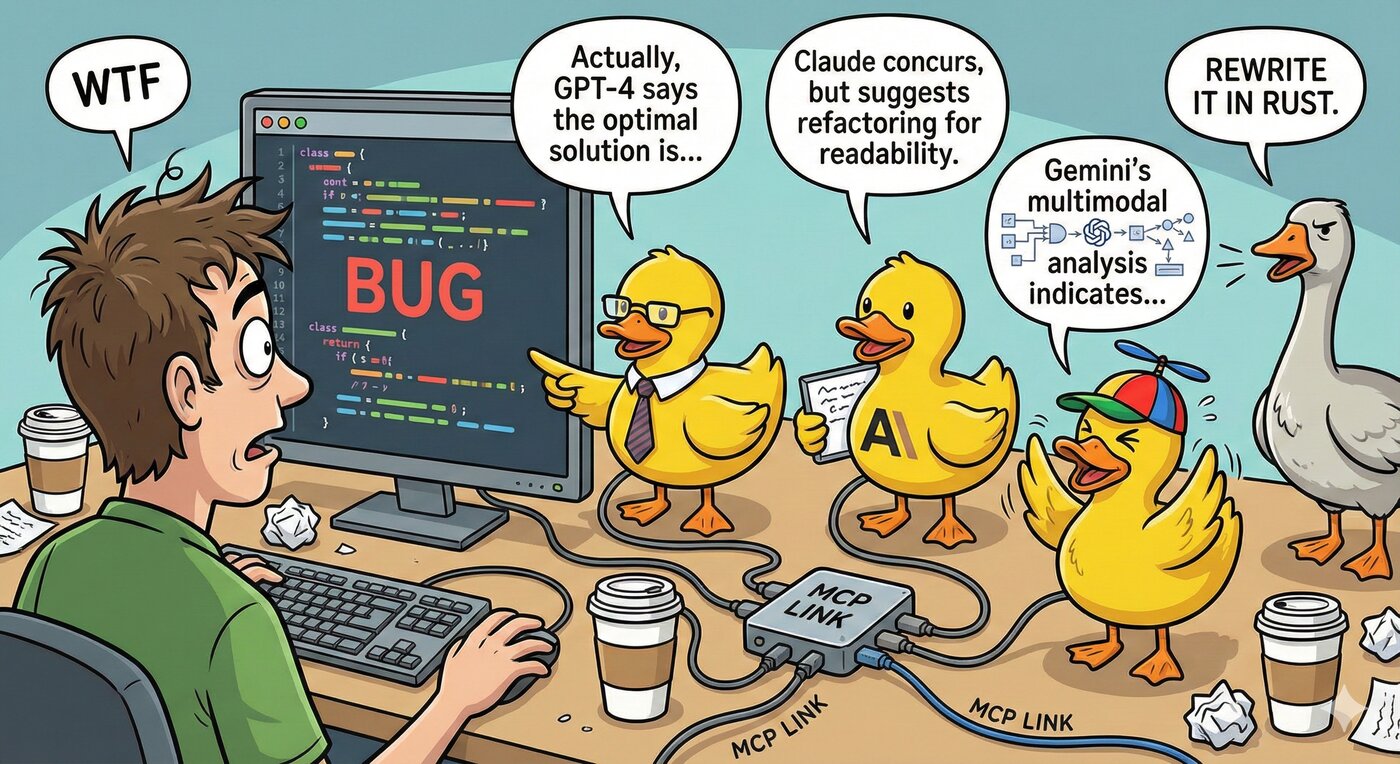
An MCP (Model Context Protocol) server that acts as a bridge to query multiple LLMs -- both OpenAI-compatible HTTP APIs and CLI coding agents. Just like rubber duck debugging, explain your problems to various AI "ducks" and get different perspectives!


<p align="center">
</p>
> Why direct provider integration? MCP's sampling primitive -- a server borrowing the host's model -- was deprecated in the 2026-07-28 spec RC in favor of servers integrating directly with LLM provider APIs. Rubber Duck has always worked this way (it brings its own ducks), so it's aligned with where the protocol is heading -- no migration required.
Features
- Universal OpenAI Compatibility -- Works with any OpenAI-compatible API endpoint
- CLI Agent Support -- Use CLI coding agents (Claude Code, Codex, Gemini CLI, Grok, Aider) as ducks
- Multiple Ducks -- Configure and query multiple LLM providers simultaneously
- Conversation Management -- Maintain context across multiple messages
- Duck Council -- Get responses from all your configured LLMs at once
- Consensus Voting -- Multi-duck voting with reasoning and confidence scores
- LLM-as-Judge -- Have ducks evaluate and rank each other's responses
- Iterative Refinement -- Two ducks collaboratively improve responses
- Structured Debates -- Oxford, Socratic, and adversarial debate formats
- MCP Prompts -- 8 reusable prompt templates for multi-LLM workflows
- Vision Input -- Send images alongside prompts to vision-capable models (docs)
- Automatic Failover -- Falls back to other providers if primary fails
- Health Monitoring -- Real-time health checks for all providers
- Usage Tracking -- Track requests, tokens, and estimated costs per provider
- MCP Bridge -- Connect ducks to other MCP servers for extended functionality (docs)
- Guardrails -- Pluggable safety layer with rate limiting, token limits, pattern blocking, and PII redaction (docs)
- Granular Security -- Per-server approval controls with session-based approvals
- Interactive UIs -- Rich HTML panels for compare, vote, debate, and usage tools (via MCP Apps)
- Tool Annotations -- MCP-compliant hints for tool behavior (read-only, destructive, etc.)
- Structured Output -- outputSchema on tools returning structured JSON for client-side validation (Cursor, VS Code/Copilot)
- Spec-Aligned by Design -- connects directly to provider APIs, the path the MCP 2026-07-28 spec recommends now that server-side sampling is deprecated (SEP-2577)
Supported Providers
HTTP Providers (OpenAI-compatible API)
Any provider with an OpenAI-compatible API endpoint, including:
- OpenAI (GPT-5.1, o3, o4-mini)
- Google Gemini (Gemini 3, Gemini 2.5 Pro/Flash)
- Anthropic (via OpenAI-compatible endpoints)
- Groq (Llama 4, Llama 3.3)
- Together AI (Llama 4, Qwen, and more)
- Perplexity (Online models with web search)
- Anyscale, Azure OpenAI, Ollama, LM Studio, Custom
CLI Providers (Coding Agents)
Command-line coding agents that run as local processes:
- Claude Code (claude) -- Codex (codex) -- Gemini CLI (gemini) -- Grok CLI (grok) -- Aider (aider) -- Custom
See CLI Providers for full setup and configuration.
Quick Start
```bash
Sign in to leave a review
Use Google, GitHub, or an email account so ratings stay tied to real people.
No reviews posted yet.