
Rierino MCP Middleware
About
Rierino MCP Middleware exposes Rierino’s full functionality over the Model Context Protocol by enabling selection of flows as MCP tools while preserving existing security policies and user roles. Any API, event processing, or CDC flow can be included as tools and triggered via…
Details
- Author
- rierino-open
- GitHub stars
- 1
- Downloads
- 283
- Categories
- Other
Jump to
- Select flows as MCP tools with existing security policies
- Supports APIs, event processing, and CDC flows as tools
- Trigger tools via REST, WebSocket, or Event Streaming
- Build servers from database access, business rules, ML models, external APIs
- Access third‑party MCP servers as middleware
- Enable MCP on any microservice for scalable, distributed execution
Configure MCP server definitions by mapping sagas as tools, setting fields like Name, Description, Tags, Status, and Parameters. To enable MCP on a microservice, create an Mcp Server Event Handler for distributed, high‑availability execution.
MCP Server & Middleware
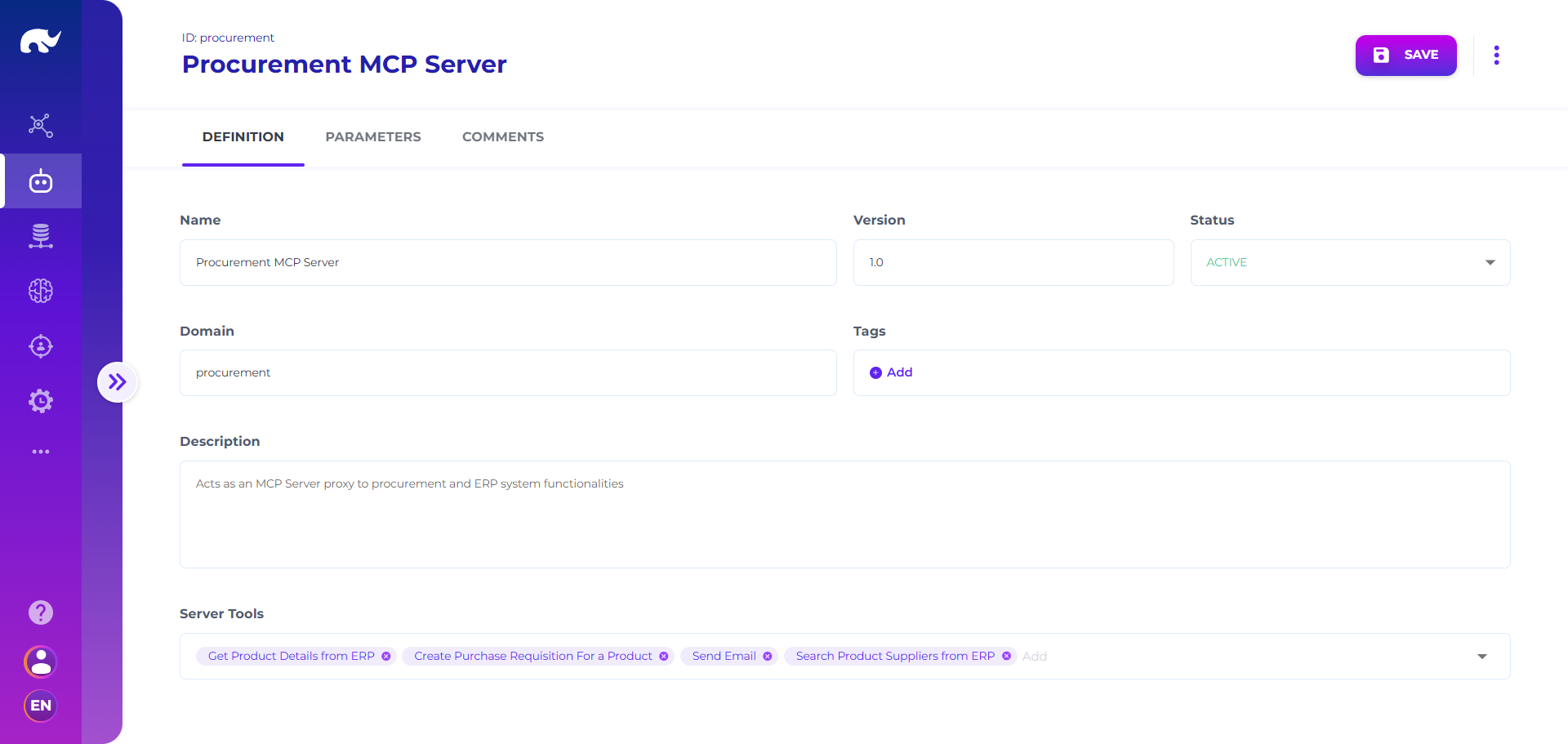
Rierino provides ability to service all of its functionality over Model Context Protocol (MCP), with a simple configuration that allows selection of flows to be serviced as tools over MCP, while maintaining already existing security policies and users roles. Any API, event processing or CDC flow can be included as MCP server tools and triggered using any protocol already supported by Rierino (e.g. REST, WebSocket, Event Streaming), going beyond the standard MCP implementations.
MCP servers can be built from scratch, using functionality such as database access, business rule evaluation, ML model prediction, external REST API calls, or could access 3rd party MCP servers acting as a middleware based on request details.
Model context protocol can be enabled on any microservice, allowing distributed execution of MCP requests in a scalable and high availability architecture by creating an Mcp Server Event Handler.
MCP server definitions allow configuration of services that are available through model context protocol through simple mapping of sagas as tools.
Initial definition of a server includes:
Name: A descriptive name
Description: Detailed description of the server
Tags: Descriptive tags for the server
Status: Whether this server should be deployed or not
Version: Current version of the server
Domain: Categorization of the server based on business domain
Comments: Historical list of comments, which typically includes information on server releases
Parameters: Server asset configurations such as tools
For learning more about Rierino, please visit https://rierino.com.
Sign in to leave a review
Use Google, GitHub, or an email account so ratings stay tied to real people.
No reviews posted yet.





