Krimto
About
Open-source memory for AI coding agents. Tell your agent to "remember" something in Cursor, Claude Code, Codex, or Gemini CLI, and Krimto saves it as a plain markdown file in a git repo you own — not rows in a vendor's database. Recall it later in a new chat, a different editor,
Details
- Author
- krimto-labs
- Downloads
- 308
- Categories
- AI, Knowledge Base, Developer Tools, Communication
Jump to
- Facts are plain markdown files in a git repo you control.
- User → team → org hierarchy governs who sees what.
- Cross-editor and cross-machine sync via one MCP server.
- Open source under Apache-2.0 license.
- SQLite + vector index for fast keyword and semantic recall.
- Self-hostable via npx or Docker on any Node 20+ system.

Setting up with Highlight
This MCP is not yet compatible with Highlight’s one-click setup. However, you can still use it with Highlight by following these steps:
- Download and install Highlight from highlightai.com/download
- Navigate to the plugins tab and select "Add Custom Plugin"
-
Configure the plugin with the settings below
Plugin Name
KrimtoCommand (node, npx, python, etc.)Please refer to the README for specific instructions on how to obtain API keys or other required environment variables.
- Enable "Start Automatically" if you want the plugin to start when Highlight launches





From the repository
Install Krimto with npx @krimto-labs/krimto init — the setup wizard detects your editor and enables automatic memory. In any supported editor (Claude Code, Cursor, Codex, Gemini CLI), tell your agent “remember X” to save a fact; later ask “what do you know about X?” to recall it. Run krimto notes in the terminal or krimto ui for a browser dashboard. For team memory, use npx @krimto-labs/krimto team init and share the join command with teammates.
Claude Desktop / Cursor
Paste into your MCP client config file to install this server.
{
    "mcpServers": {
        "krimto": {
            "krimto": {
                "command": "npx",
                "args": [
                    "-y",
                    "@krimto-labs/krimto"
                ]
            }
        }
    }
}McpServers
{
    "krimto": {
        "command": "npx",
        "args": [
            "-y",
            "@krimto-labs/krimto"
        ]
    }
}
Krimto
> Open-source memory for AI coding agents you own in git — governed by a real user→team→org hierarchy, not a vendor database. Solo to team. Apache-2.0.



Your agent's memory, as markdown in your own git — synced across every editor and machine. Tell your
agent "remember X" in any editor and it saves a durable, attributable fact; ask later — in a new chat,
a different editor, or on another machine — and it recalls the right answer. One command, no account,
no vendor database: your memory follows you.
You own it: every fact is a plain markdown file in a git repo you control — readable, reviewable in a
PR, and yours. When a teammate joins, that same memory becomes a shared team brain governed by a real
user → team → org hierarchy (the most specific scope wins at recall) — the one primitive no other
memory tool ships. Solo is free; the governance is what you grow into.
See it
One npx command sets it up; then your agent saves a fact in Claude Code and recalls it in Cursor —
no account, no database:
<!-- media/krimto-demo.gif is the lead demo (docs/ is gitignored, so the README can't link there).
The full three-demo storyboard lives at docs/demos/krimto-demos.html (local). -->
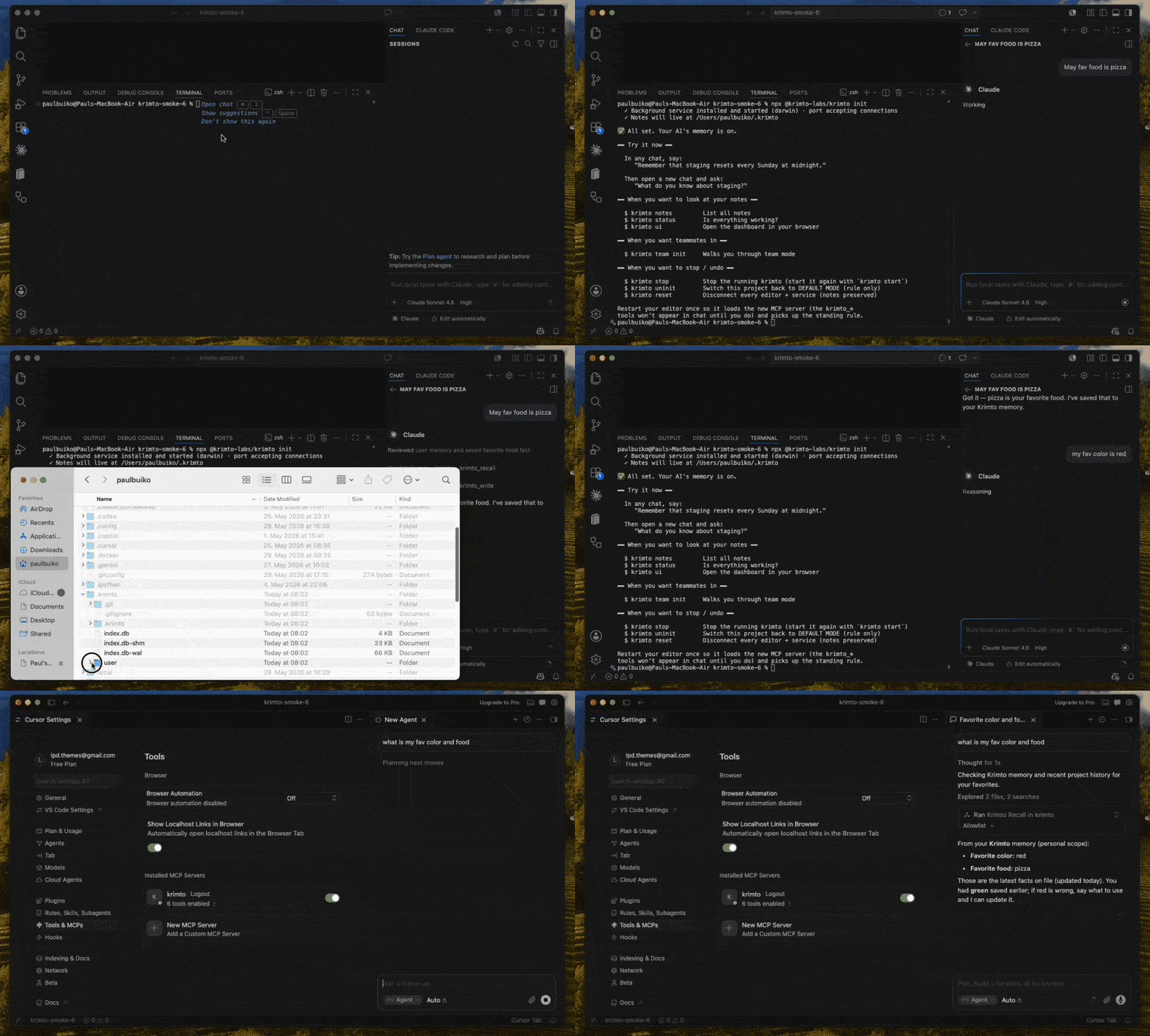
Three short demos — solo (remember in Claude Code, recall in Cursor), cross-machine (write,
git push, recall on another laptop), and team (a teammate's fact reaches you; your personal notes
stay yours).
Because every memory is just a file in your git, you can read it yourself — no API, no dashboard needed:
$ cat ~/.krimto/user/you@example.com/favorite-color.md
---
id: fct_01KT3BDSYY1KK80SG3S7KBEV58
scope: user/you@example.com
title: Favorite color
author: you@example.com
created: 2026-06-02T05:03:14Z
updated: 2026-06-02T05:03:14Z
tags:
  - personal
source: claude-code
---
User's favorite color is red.
$ git -C ~/.krimto log --oneline -1

8bc5b86 krimto: write batch — 1 fact
That's the whole bet: your agent's memory is plain markdown in a git repo you own — not rows in
someone else's database.
Why Krimto
- You own it, in your git. Every fact is a markdown file in a git repo you control — git log the
audit trail, edit it in any editor, review it in a pull request. No vendor database, no lock-in.
- Governed user → team → org hierarchy. Knowledge is scoped to a person, a team, or the whole
company, and the most specific scope wins at recall — a server-enforced primitive no other memory
tool ships for free.
- Follows you everywhere — cross-vendor, Apache-2.0. One MCP server syncs the same memory across
Claude Code, Cursor, Codex, Gemini CLI and more — every editor and machine. Fully open source, with
no managed-service restriction.
Try it in 2 minutes (solo, no account)
npx @krimto-labs/krimto init
The setup wizard detects your editor, wires it up, and turns on automatic memory. Then, in any chat:
"Remember that our staging DB resets every Sunday."
Open a new chat and ask:
"What do you know about staging?" → it remembers.
See your notes with krimto notes (terminal) or krimto ui (browser dashboard). Your data lives in
~/.krimto — the same folder no matter which project you're working in.
Connect your agent
krimto init wires supported editors for you. What auto-connects vs. needs one copy-paste step:
| Editor | Setup |
|---|---|
| Cursor | auto-connects |
| Claude Code | auto-connects |
| Codex | manual snippet |
| Gemini CLI | manual snippet |
To connect any MCP client manually, point it at Krimto over stdio:
claude mcp add krimto -- npx -y @krimto-labs/krimto
…or the config-file form (Cursor, Codex, Gemini CLI, etc. use the same shape):
{ "mcpServers": { "krimto": { "command": "npx", "args": ["-y", "@krimto-labs/krimto"] } } }
By default an agent uses Krimto only when you ask. Running krimto init once in your project drops a
standing rule so it uses Krimto on its own.
Install as a Claude Code plugin
Prefer Claude Code's plugin system? Add Krimto's marketplace and install it directly:
/plugin marketplace add krimto-labs/krimto
/plugin install krimto@krimto
This bundles the MCP server together with Krimto's skills, the /krimto-status command, and the
memory hooks — no separate krimto init needed.
How it works
Three layers, one source of truth:
1. Storage — facts are markdown files in a git repository (the source of truth; git is the audit log).
2. Index — a SQLite + sqlite-vec hybrid index (keyword + vector) for fast retrieval, with scope
precedence applied at ranking time.
3. Access — an API server enforces who can read and write each scope (user / team / org).
Team mode
When you're ready to share memory with teammates:
npx @krimto-labs/krimto team init
This walks you through an admin email, your org/team name, an optional shared git remote, and
teammate invites — then prints a join command for each teammate:
krimto join --server <url> --key <key>
Teammates can connect to one shared server, or each run their own Krimto synced over a shared git
remote. Personal and team notes live together and sync as a unit. Step back to solo any time with
krimto team disband (your notes are preserved).
Self-host
Krimto runs anywhere Node 20+ runs.
```bash
Sign in to leave a review
Use Google, GitHub, or an email account so ratings stay tied to real people.
No reviews posted yet.