ESP-IDF
About
Streamlines ESP-IDF project building with automatic environment setup and error handling for ESP32 microcontroller development.
Details
- Author
- horw
- Repository
- horw/esp-mcp
- GitHub stars
- 9
- Downloads
- 353
- Categories
- Developer Tools, Design, AI, Infrastructure, Frontend, Project Management, Other
Jump to
- Install ESP-IDF dependencies and toolchain via install.sh.
- Create new ESP-IDF projects.
- Set target chip for projects (e.g., esp32, esp32c3, esp32s3).
- Build projects with incremental build support.
- List available serial ports for ESP devices.
- Flash built firmware to connected devices.
- Run pytest tests with pytest-embedded support.
- Flexible per-project ESP-IDF path management.
- SDK config management using custom sdkconfig_defaults files.
- Build time tracking and optional port specification for flashing.

Setting up with Highlight
This MCP is not yet compatible with Highlight’s one-click setup. However, you can still use it with Highlight by following these steps:
- Download and install Highlight from highlightai.com/download
- Navigate to the plugins tab and select "Add Custom Plugin"
-
Configure the plugin with the settings below
Plugin Name
ESP-IDFCommand (node, npx, python, etc.)<path_to_uv_or_python_executable>Arguments-
Argument 1
--directory -
Argument 2
<path_to_cloned_esp-mcp_repository> -
Argument 3
run -
Argument 4
main.py
Environment-
IDF_PATH
<path_to_your_esp-idf_directory>
Please refer to the README for specific instructions on how to obtain API keys or other required environment variables.
-
Argument 1
- Enable "Start Automatically" if you want the plugin to start when Highlight launches





From the repository
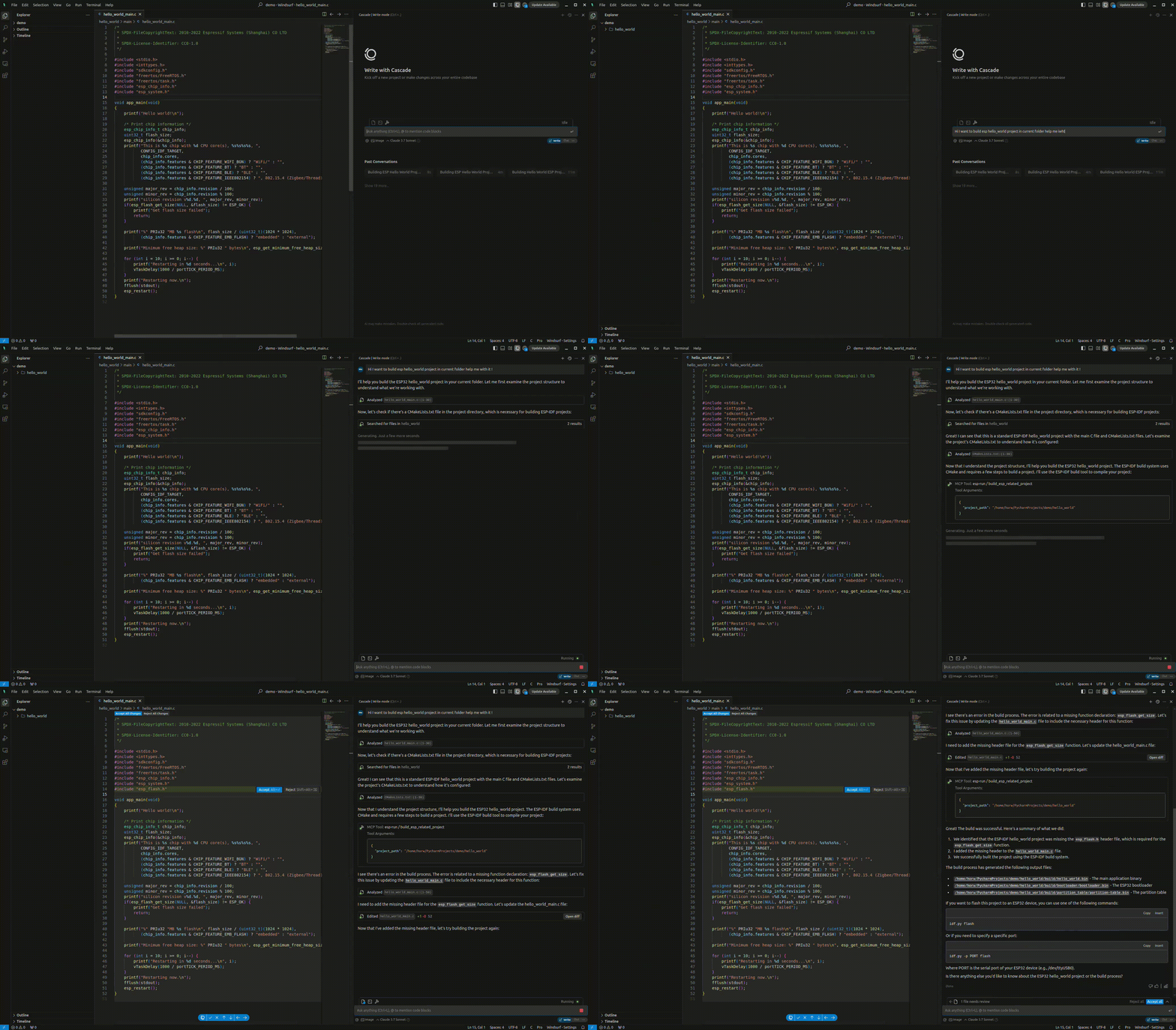
Once the esp-mcp server is configured and running, your LLM or chatbot can interact with it using the tools defined in this MCP. For example, you could ask your chatbot to:
"Install ESP-IDF dependencies for the ESP-IDF installation at /path/to/esp-idf."
"Set the target chip to esp32s3 for the project in /path/to/my/esp-project."
"Build the project located at /path/to/my/esp-project using the esp-mcp."
"Build the project with custom sdkconfig defaults: sdkconfig.defaults;sdkconfig.ci.release."
"Run pytest tests for the project at /path/to/my/esp-project targeting esp32c3."
"Flash the firmware to my connected ESP32 device for the project in my_app."
The MCP server will then execute the corresponding ESP-IDF commands (like idf.py build, idf.py set-target, idf.py flash, pytest) based on the tools implemented in main.py.
The result.gif below shows an example interaction:
run_esp_idf_install
Install ESP-IDF dependencies and toolchain via install.sh.
create_esp_project
Create a new ESP-IDF project.
setup_project_esp_target
Set target chip for ESP-IDF projects (e.g., esp32, esp32c3, esp32s3).
build_esp_project
Build ESP-IDF projects with incremental build support.
list_esp_serial_ports
List available serial ports for ESP devices.
flash_esp_project
Flash built firmware to connected ESP devices.
run_pytest
Run pytest tests with pytest-embedded support for ESP-IDF projects.
Claude Desktop / Cursor
Paste into your MCP client config file to install this server.
{
    "mcpServers": {
        "esp-idf": {
            "env": {
                "IDF_PATH": "<path_to_your_esp-idf_directory>"
            },
            "args": [
                "--directory",
                "<path_to_cloned_esp-mcp_repository>",
                "run",
                "main.py"
            ],
            "command": "<path_to_uv_or_python_executable>"
        }
    }
}Linux
{
    "env": {
        "IDF_PATH": "<path_to_your_esp-idf_directory>"
    },
    "args": [
        "--directory",
        "<path_to_cloned_esp-mcp_repository>",
        "run",
        "main.py"
    ],
    "command": "<path_to_uv_or_python_executable>"
}
Macos
{
    "env": {
        "IDF_PATH": "<path_to_your_esp-idf_directory>"
    },
    "args": [
        "--directory",
        "<path_to_cloned_esp-mcp_repository>",
        "run",
        "main.py"
    ],
    "command": "<path_to_uv_or_python_executable>"
}
Windows
{
    "env": {
        "IDF_PATH": "<path_to_your_esp-idf_directory>"
    },
    "args": [
        "--directory",
        "<path_to_cloned_esp-mcp_repository>",
        "run",
        "main.py"
    ],
    "command": "<path_to_uv_or_python_executable>"
}
Goal
The goal of this MCP is to: - Consolidate ESP-IDF and related project commands in one place. - Simplify getting started using only LLM communication.How to contribute to the project
Simply find a command that is missing from this MCP and create a PR for it!
If you want someone to help you with this implementation, just open an issue.
Notice
This project is currently a Proof of Concept (PoC) for an MCP server tailored for ESP-IDF workflows.Current Capabilities:
Core Features:
run_esp_idf_install: Install ESP-IDF dependencies and toolchain via install.sh.
create_esp_project: Create a new ESP-IDF project.
setup_project_esp_target: Set target chip for ESP-IDF projects (esp32, esp32c3, esp32s3, etc.).
build_esp_project: Build ESP-IDF projects with incremental build support.
list_esp_serial_ports: List available serial ports for ESP devices.
flash_esp_project: Flash built firmware to connected ESP devices.
run_pytest: Run pytest tests with pytest-embedded support for ESP-IDF projects.
Additional Features:
Flexible ESP-IDF path management: supports per-project ESP-IDF versions via idf_path parameter.
SDK config management: supports custom sdkconfig_defaults files for build configuration (multiple files can be specified separated by semicolons).
Build time tracking for performance monitoring.
Optional port specification for flashing operations.
Includes experimental support for automatic issue fixing based on build logs.
Vision & Future Work:
The long-term vision is to expand this MCP into a comprehensive toolkit for interacting with embedded devices, potentially integrating with home assistant platforms, and streamlining documentation access for ESP-IDF and related technologies.
We envision features such as:
Broader ESP-IDF command support (e.g., monitor, menuconfig interaction if feasible).
Device management and information retrieval.
Integration with other embedded development tools and platforms.
Your ideas and contributions are welcome! Please feel free to discuss them by opening an issue.
Install
First, clone this MCP repository:
git clone git@github.com:horw/esp-mcp.git
Then, configure it in your chatbot.
The JSON snippet below is an example of how you might configure this esp-mcp server within a chatbot or an agent system that supports the Model Context Protocol (MCP). The exact configuration steps and format may vary depending on the specific chatbot system you are using. Refer to your chatbot's documentation for details on how to integrate MCP servers.
{
    "mcpServers": {
        "esp-run": { // "esp-run" is an arbitrary name you can assign to this server configuration.
            "command": "<path_to_uv_or_python_executable>",
            "args": [
                "--directory",
                "<path_to_cloned_esp-mcp_repository>", // e.g., /path/to/your/cloned/esp-mcp
                "run",
                "main.py" // If using python directly, this might be just "main.py" and command would be your python interpreter
            ],
            "env": {
                "IDF_PATH": "<path_to_your_esp-idf_directory>" // e.g., ~/esp/esp-idf or C:\\Espressif\\frameworks\\esp-idf
            }
        }
    }
}
A few notes on the configuration:
command: This should be the full path to your uv executable if you are using it, or your Python interpreter (e.g., /usr/bin/python3 or C:\\Python39\\python.exe) if you plan to run main.py directly.
args:
The first argument to --directory should be the absolute path to where you cloned the esp-mcp repository.
If you're using uv, the arguments run main.py are appropriate. If you're using Python directly, you might only need main.py in the args list, and ensure your command points to the Python executable.
IDF_PATH: (Optional) This environment variable can point to the root directory of your ESP-IDF installation. ESP-IDF is Espressif's official IoT Development Framework. If you haven't installed it, please refer to the official ESP-IDF documentation for installation instructions. Note: All tools support an idf_path parameter that can be manually specified when calling the tool, allowing you to use different ESP-IDF versions for different projects without setting the environment variable. If idf_path is not provided, the tool will use the IDF_PATH environment variable if available.
Usage
Once the esp-mcp server is configured and running, your LLM or chatbot can interact with it using the tools defined in this MCP. For example, you could ask your chatbot to:
"Install ESP-IDF dependencies for the ESP-IDF installation at /path/to/esp-idf."
"Set the target chip to esp32s3 for the project in /path/to/my/esp-project."
"Build the project located at /path/to/my/esp-project using the esp-mcp."
"Build the project with custom sdkconfig defaults: sdkconfig.defaults;sdkconfig.ci.release."
"Run pytest tests for the project at /path/to/my/esp-project targeting esp32c3."
"Flash the firmware to my connected ESP32 device for the project in my_app."
The MCP server will then execute the corresponding ESP-IDF commands (like idf.py build, idf.py set-target, idf.py flash, pytest) based on the tools implemented in main.py.
The result.gif below shows an example interaction:
Examples
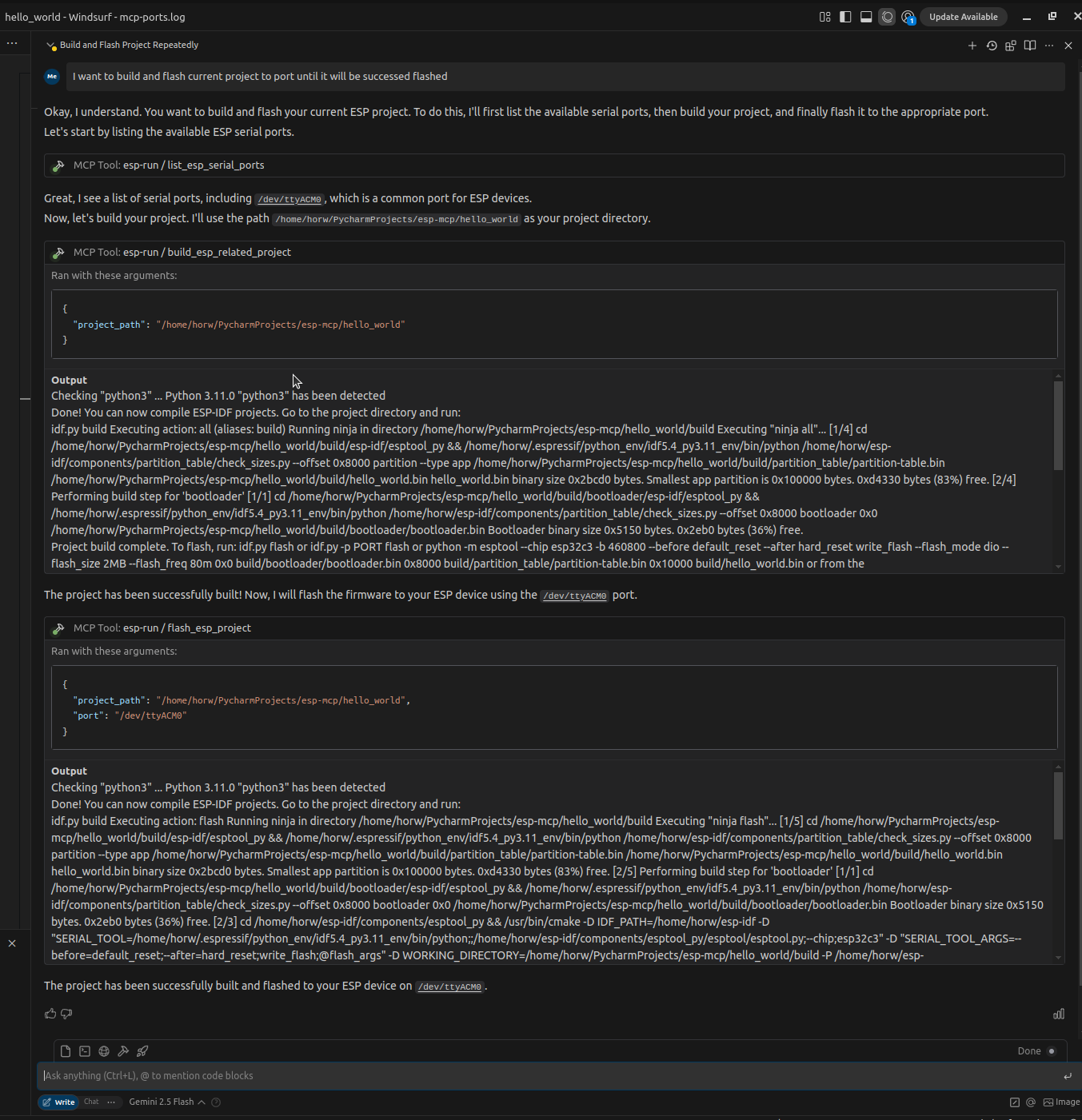
1. Build and Flash
Star History
Sign in to leave a review
Use Google, GitHub, or an email account so ratings stay tied to real people.
No reviews posted yet.