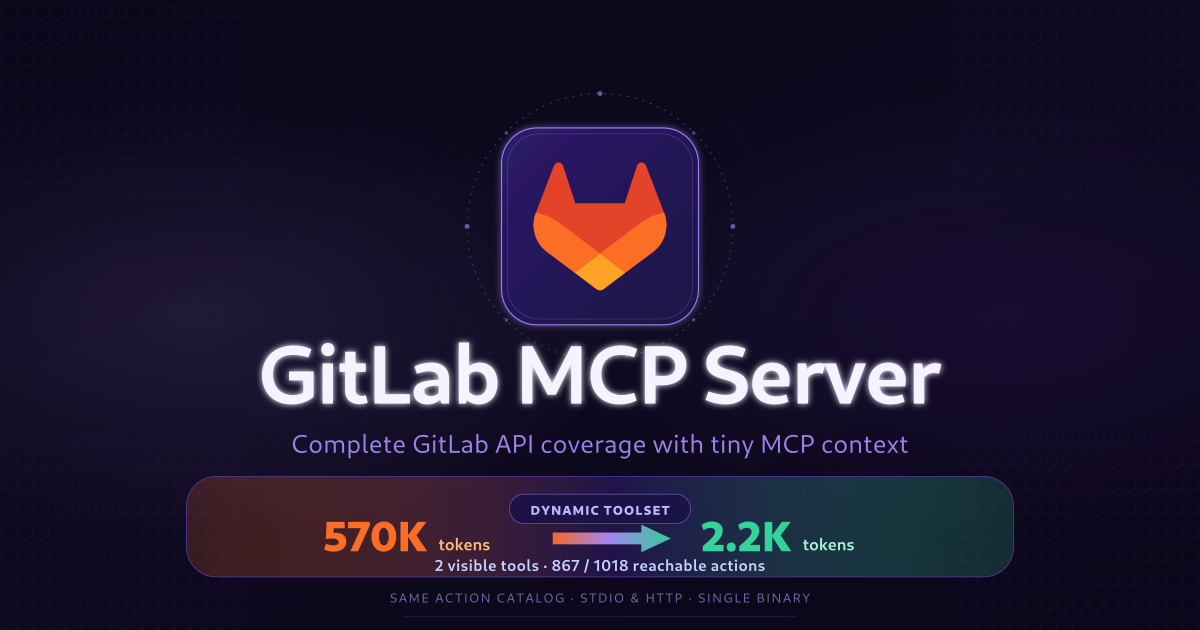

Gitlab Mcp Server
About
Model Context Protocol (MCP) server for GitLab — exposes 1006 GitLab REST & GraphQL API operations as MCP tools (28 meta-tools / 43 enterprise), 24 resources, 38 prompts, and 17 completion types for AI assistants. Written in Go, single static binary, stdio and HTTP transport.
Details
- Author
- jmrplens
- GitHub stars
- 31
- Downloads
- 574
- Categories
- Developer Tools, Other, Infrastructure, Project Management, API
Jump to
- Plain-language GitLab – the AI translates natural requests into API calls.
- 1000+ tools covering the full GitLab platform (REST + GraphQL).
- Low-token default dynamic surface (exposes 2 tools, reaches the full catalog).
- Proven with real models – 99.5% aggregate success across thousands of operations.
- Safe by design – read-only mode, safe mode (dry-run preview), and TLS options.
- Runs anywhere – one static binary or container; amd64 & arm64; stdio and HTTP.

Setting up with Highlight
This MCP is not yet compatible with Highlight’s one-click setup. However, you can still use it with Highlight by following these steps:
- Download and install Highlight from highlightai.com/download
- Navigate to the plugins tab and select "Add Custom Plugin"
-
Configure the plugin with the settings below
Plugin Name
Gitlab Mcp ServerCommand (node, npx, python, etc.)Please refer to the README for specific instructions on how to obtain API keys or other required environment variables.
- Enable "Start Automatically" if you want the plugin to start when Highlight launches





From the repository
Choose an installation method: one-click buttons (VS Code, Cursor, etc.), claude mcp add command, the built-in setup wizard (gitlab-mcp-server --setup), or manual JSON configuration. Provide a GitLab Personal Access Token with the api scope. For self-managed GitLab, set the GITLAB_URL environment variable. Then simply ask your AI assistant to perform GitLab tasks.
Claude Desktop / Cursor
Paste into your MCP client config file to install this server.
{
    "mcpServers": {
        "gitlab mcp server": {
            "gitlab-mcp-server-jmrplens": {
                "command": "docker",
                "args": [
                    "pull",
                    "ghcr.io/jmrplens/gitlab-mcp-server:latest"
                ]
            }
        }
    }
}McpServers
{
    "gitlab-mcp-server-jmrplens": {
        "command": "docker",
        "args": [
            "pull",
            "ghcr.io/jmrplens/gitlab-mcp-server:latest"
        ]
    }
}
GitLab MCP Server
<p align="center">




</p>
Connect your AI assistant to GitLab so it can review merge requests, triage pipelines, manage issues, and draft releases — in plain language. One static binary (or a container), 1000+ GitLab tools over the full REST + GraphQL API, working with Claude, Cursor, VS Code, and any MCP client.
You talk to your AI assistant; it does the GitLab work. No project IDs, API endpoints, or JSON to remember.
> "Review merge request !15 — is it safe to merge?" · "Why did the last pipeline fail?" · "List open issues assigned to me" · "Generate release notes from v1.0 to v2.0"
---
> 🤖 Using an AI assistant? Give it this repository URL and ask it to install the server for your client. Everything a model needs to do it headlessly — the declarative per-client config, claude mcp add one-liners, and defaults — is in llms.txt (no interactive wizard required).
Install in 60 seconds
Pick one. Each path ends with you typing a prompt to your assistant.
One-click install
<table>
<tr>
<th align="left">Client</th>
<th align="left">One-click button</th>
<th align="left">Token step</th>
</tr>
<tr>
<td><b>VS Code</b></td>
<td><a href="https://insiders.vscode.dev/redirect/mcp/install?name=gitlab&config=%7B%22command%22%3A%22docker%22%2C%22args%22%3A%5B%22run%22%2C%22-i%22%2C%22--rm%22%2C%22-e%22%2C%22GITLAB_TOKEN%22%2C%22ghcr.io%2Fjmrplens%2Fgitlab-mcp-server%3Alatest%22%2C%22--http%3Dfalse%22%5D%2C%22env%22%3A%7B%22GITLAB_TOKEN%22%3A%22%24%7Binput%3Agitlab_token%7D%22%7D%2C%22inputs%22%3A%5B%7B%22id%22%3A%22gitlab_token%22%2C%22type%22%3A%22promptString%22%2C%22description%22%3A%22GitLab%20Personal%20Access%20Token%20%28api%20scope%29%22%2C%22password%22%3Atrue%7D%5D%7D">
<td>prompts you (masked)</td>
</tr>
<tr>
<td><b>VS Code Insiders</b></td>
<td><a href="https://insiders.vscode.dev/redirect/mcp/install?name=gitlab&config=%7B%22command%22%3A%22docker%22%2C%22args%22%3A%5B%22run%22%2C%22-i%22%2C%22--rm%22%2C%22-e%22%2C%22GITLAB_TOKEN%22%2C%22ghcr.io%2Fjmrplens%2Fgitlab-mcp-server%3Alatest%22%2C%22--http%3Dfalse%22%5D%2C%22env%22%3A%7B%22GITLAB_TOKEN%22%3A%22%24%7Binput%3Agitlab_token%7D%22%7D%2C%22inputs%22%3A%5B%7B%22id%22%3A%22gitlab_token%22%2C%22type%22%3A%22promptString%22%2C%22description%22%3A%22GitLab%20Personal%20Access%20Token%20%28api%20scope%29%22%2C%22password%22%3Atrue%7D%5D%7D&quality=insiders">
<td>prompts you (masked)</td>
</tr>
<tr>
<td><b>Cursor</b></td>
<td><a href="https://cursor.com/install-mcp?name=gitlab&config=eyJjb21tYW5kIjoiZG9ja2VyIiwiYXJncyI6WyJydW4iLCItaSIsIi0tcm0iLCItZSIsIkdJVExBQl9UT0tFTiIsImdoY3IuaW8vam1ycGxlbnMvZ2l0bGFiLW1jcC1zZXJ2ZXI6bGF0ZXN0IiwiLS1odHRwPWZhbHNlIl0sImVudiI6eyJHSVRMQUJfVE9LRU4iOiJZT1VSX0dJVExBQl9UT0tFTiJ9fQ%3D%3D"> </a></td>
<td>edit <code>YOUR_GITLAB_TOKEN</code></td>
</tr>
<tr>
<td><b>LM Studio</b></td>
<td><a href="https://lmstudio.ai/install-mcp?name=gitlab&config=eyJjb21tYW5kIjoiZG9ja2VyIiwiYXJncyI6WyJydW4iLCItaSIsIi0tcm0iLCItZSIsIkdJVExBQl9UT0tFTiIsImdoY3IuaW8vam1ycGxlbnMvZ2l0bGFiLW1jcC1zZXJ2ZXI6bGF0ZXN0IiwiLS1odHRwPWZhbHNlIl0sImVudiI6eyJHSVRMQUJfVE9LRU4iOiJZT1VSX0dJVExBQl9UT0tFTiJ9fQ%3D%3D"> </a></td>
<td>edit <code>YOUR_GITLAB_TOKEN</code></td>
</tr>
<tr>
<td><b>Kiro</b></td>
<td><a href="https://kiro.dev/launch/mcp/add?name=gitlab&config=%7B%22command%22%3A%22docker%22%2C%22args%22%3A%5B%22run%22%2C%22-i%22%2C%22--rm%22%2C%22-e%22%2C%22GITLAB_TOKEN%22%2C%22ghcr.io%2Fjmrplens%2Fgitlab-mcp-server%3Alatest%22%2C%22--http%3Dfalse%22%5D%2C%22env%22%3A%7B%22GITLAB_TOKEN%22%3A%22YOUR_GITLAB_TOKEN%22%7D%7D"> </a></td>
<td>edit <code>YOUR_GITLAB_TOKEN</code></td>
</tr>
<tr>
<td><b>Claude Desktop</b></td>
<td><a href="https://github.com/jmrplens/gitlab-mcp-server/releases/latest/download/gitlab-mcp-server.mcpb">
<td>settings UI (keychain)</td>
</tr>
</table>
Each button registers the Docker-based server (auto-pulls the image on first run; you need Docker installed). The Claude Desktop row instead downloads a native .mcpb desktop extension (macOS universal + Windows, no Docker) — open it with Claude Desktop and fill in the settings. Need a token? Create a Personal Access Token with the api scope. Self-managed GitLab? Add a GITLAB_URL env var in your client's MCP config after install.
Claude Code (claude mcp add)
Docker (no install — pulls the image on first run):
claude mcp add gitlab --env GITLAB_TOKEN=glpat-xxxx --transport stdio \
  -- docker run -i --rm -e GITLAB_TOKEN ghcr.io/jmrplens/gitlab-mcp-server:latest --http=false
Or install the native binary first, then register it:
```bash
Sign in to leave a review
Use Google, GitHub, or an email account so ratings stay tied to real people.
No reviews posted yet.





