
Evermemos Mcp
About
Universal long-term memory layer for AI coding assistants, powered by EverMemOS.
Details
- Author
- tt-a1i
- GitHub stars
- 16
- Downloads
- 286
- Categories
- Other, AI
Jump to
- Space isolation with domain:slug per project or topic
- Multi‑space search across up to 10 spaces in one call
- Sensitive content guard blocking API keys, passwords, tokens
- Memory conflict detection in chat spaces
- Lifecycle tracking: queued, provisional, fallback, searchable
- Git auto‑detection infers space from remote repository name

Setting up with Highlight
This MCP is not yet compatible with Highlight’s one-click setup. However, you can still use it with Highlight by following these steps:
- Download and install Highlight from highlightai.com/download
- Navigate to the plugins tab and select "Add Custom Plugin"
-
Configure the plugin with the settings below
Plugin Name
Evermemos McpCommand (node, npx, python, etc.)Please refer to the README for specific instructions on how to obtain API keys or other required environment variables.
- Enable "Start Automatically" if you want the plugin to start when Highlight launches





From the repository
Get an API key from EverMemOS Cloud, then add the server to your MCP client configuration with the EVERMEMOS_API_KEY environment variable. Run via uvx evermemos-mcp@latest. Works with Claude Code, Cursor, Cline, Cherry Studio, OpenClaw, Gemini CLI, Aider, and any MCP‑compatible client.
list_spaces
List MCP-visible memory spaces that this server can route and recover. Call this first to discover which space_id values are available before using other memory tools. Each space isolates memories by project or topic (e.g. coding:my-app, study:ml-notes, chat:preferences). Note: some native EverMemOS Cloud spaces created outside the MCP naming and catalog flow may not appear here. If no spaces exist yet, create one by calling remember with a new space_id and description.
remember
Store information in long-term memory within a specific space. Use this proactively to save architecture decisions, user preferences, project conventions, bug solutions, and key context. Content is queued for AI extraction and becomes searchable only after upstream processing completes. For important writes, prefer remember(include_status=true) so the write-after status check runs immediately. Use request_status, recall, or briefing to distinguish queued, provisional, fallback, and searchable states. Set flush=true at end of session or topic switch; flush=false during ongoing work. Provide a description when creating a new space for the first time.
request_status
Check the async processing status for a prior remember request. Use this when remember returned a request_id and you need to know whether extraction is still queued or has been reported complete by upstream. Check success/error first, then interpret lifecycle.state.
recall
Search for relevant memories in one or more spaces. Use this when you need context about prior decisions, preferences, conventions, or anything discussed in previous sessions. Returns matching memories with traceable citations (memory_type, snippet, timestamp, relevance score). Also reports whether current results are searchable, provisional, or fallback. Pending signals depend on upstream pending_messages support and may be absent even while extraction is still in progress. If you need chronological review, delete verification, or a complete timeline, prefer fetch_history instead of relying on relevance-ranked recall alone. If space_id and space_ids are both omitted, auto-detected from git remote (coding:<repo-name>).
briefing
Get a structured context briefing for a memory space. Call this at the start of a new session to restore high-value context quickly. Returns: user profile, recent episodes, key facts, and foresights. When formal profile memories are unavailable, briefing may surface explicit fallback metadata and label it as such. This is the fastest way to catch up on the most important currently available context in a space.
forget
Request deletion of specific memories from a space. Use fetch_history or recall to identify targets first — results may include a parent_id (memcell ID) which is the effective delete key used by EverMemOS Cloud. The server resolves parent_id automatically when available (recent 100 items per type). Verify deletion afterwards with fetch_history; some IDs may remain unmatched if the memory was already deleted or outside the resolution window.
fetch_history
Page through historical memories in a space by memory_type. Useful for chronological timeline review when recall's relevance ranking is not sufficient, or when you need to browse all memories of a type. This is the primary tool for timeline review, pre-delete verification, and post-delete re-checks.
Claude Desktop / Cursor
Paste into your MCP client config file to install this server.
{
    "mcpServers": {
        "evermemos mcp": {
            "evermemos-mcp": {
                "type": "stdio",
                "command": "uvx",
                "args": [
                    "evermemos-mcp@latest"
                ],
                "env": {
                    "EVERMEMOS_API_KEY": "<YOUR_API_KEY>",
                    "EVERMEMOS_USER_ID": "mcp-user"
                }
            }
        }
    }
}McpServers
{
    "evermemos-mcp": {
        "type": "stdio",
        "command": "uvx",
        "args": [
            "evermemos-mcp@latest"
        ],
        "env": {
            "EVERMEMOS_API_KEY": "<YOUR_API_KEY>",
            "EVERMEMOS_USER_ID": "mcp-user"
        }
    }
}
evermemos-mcp



Long-term memory for AI coding assistants. Remember once, recall forever.
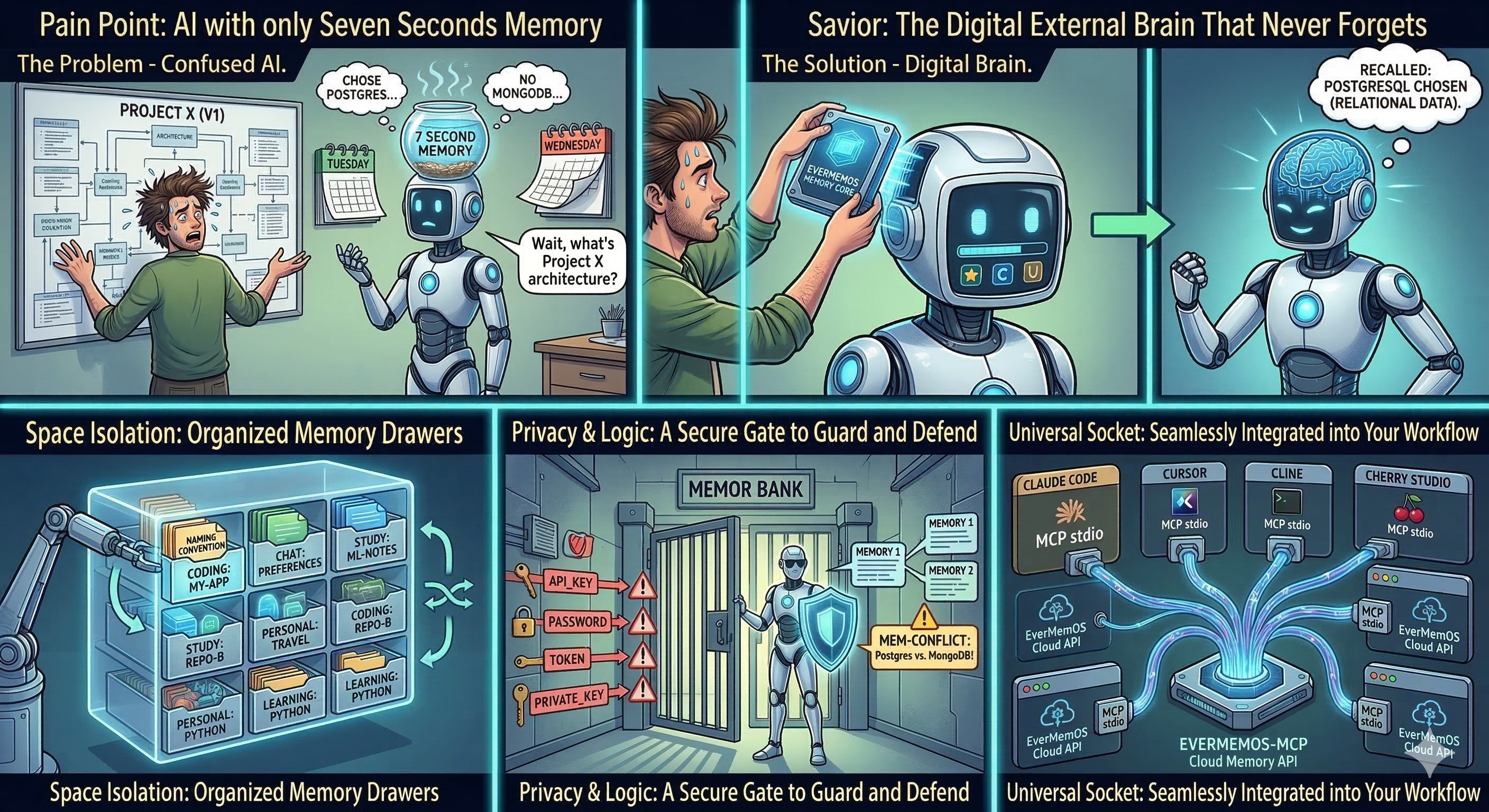
You spent thirty minutes explaining your architecture, naming conventions, and why you dropped MongoDB. Next session — gone. You explain it all over again.
evermemos-mcp fixes this. One remember call stores it. One briefing call brings it back — across any session, any client.
> Benchmark: 60/60 recall vs 0/60 baseline. Zero attribution errors. P95 < 2s. (evidence)
> Intro video: Watch on Bilibili
> Demo video: Watch on Bilibili
---
Quick Start
Get your API key from EverMemOS Cloud, then add to your MCP client config:
{
  "mcpServers": {
    "evermemos-mcp": {
      "type": "stdio",
      "command": "uvx",
      "args": ["evermemos-mcp@latest"],
      "env": {
        "EVERMEMOS_API_KEY": "your-key-here"
      }
    }
  }
}
Or run directly:
uvx evermemos-mcp@latest
Works with Claude Code, Cursor, Cline, Cherry Studio, OpenClaw, Gemini CLI, Aider, and any MCP-compatible client or agent. See docs/05-client-integrations.md for client-specific setup.
<details>
<summary>Install from source</summary>
git clone https://github.com/tt-a1i/evermemos-mcp.git
cd evermemos-mcp
cp .env.example .env   # set EVERMEMOS_API_KEY
uv run evermemos-mcp
MCP client config for source installs:
{
  "mcpServers": {
    "evermemos-mcp": {
      "type": "stdio",
      "command": "uv",
      "args": ["run", "--directory", "/path/to/evermemos-mcp", "evermemos-mcp"],
      "env": { "EVERMEMOS_API_KEY": "your-key-here" }
    }
  }
}
</details>
---
What You Get
7 Tools
| Tool | What it does |
|------|-------------|
| list_spaces | Discover available memory spaces |
| remember | Store context into long-term memory. Auto-detects sensitive content (API keys, passwords) and checks for conflicting memories |
| request_status | Check if a queued write has been extracted |
| recall | Search memories with 6 retrieval strategies (keyword / hybrid / vector / RRF / agentic / auto) |
| briefing | One-call session-start context restore: profile + episodes + facts + foresights |
| forget | Targeted deletion with verification workflow |
| fetch_history | Paginate through memory timeline by type |
Key Capabilities
- Space isolation — coding:my-app, chat:preferences, study:ml-notes — memories never bleed across projects
- Multi-space search — Query up to 10 spaces in one recall call with automatic source attribution
- Sensitive content guard — Blocks API keys, passwords, tokens, private keys before storing. Asks user to confirm
- Memory conflict detection — Auto-checks for similar memories in chat: spaces. Surfaces conflicts so the agent can decide
- Lifecycle tracking — Every result labeled queued, provisional, fallback, or searchable across all tools
- Traceable citations — memory_type, snippet, timestamp, score, source_message_id on every result
- Git auto-detection — Omit space_id and it infers coding:<repo-name> from git remote
- Robust error handling — Retry with backoff (429/5xx), GET body fallback for proxy/WAF, structured error codes
---
Use Cases
Persistent architecture context:
You: remember we chose PostgreSQL because our data is highly relational

     [space_id: coding:my-saas]
-- next day, new session --
You: what database did we choose and why?

     → "Chose PostgreSQL — highly relational data model"
Personal preferences that stick:
You: remember I prefer dark mode, vim keybindings, and concise responses

     [space_id: chat:preferences]
-- any future session --
You: recall my UI preferences

     → "dark mode, vim keybindings, concise responses"
Cross-session learning notes:
You: remember bias-variance tradeoff — high bias = underfitting, high variance = overfitting

     [space_id: study:ml-notes]
-- later --
You: briefing for study:ml-notes

     → profile + recent episodes + key facts + foresights
---
Why evermemos-mcp
There are other memory MCP servers. Here's what makes this one different:
| | evermemos-mcp | Mem0 MCP | Letta/MemGPT | Official MCP memory |
|---|---|---|---|---|
| Space isolation | domain:slug per project/topic | No | No | No |
| Lifecycle tracking | queued → provisional → fallback → searchable | No | No | No |
| Sensitive content guard | API keys, passwords, tokens blocked | No | No | No |
| Conflict detection | Auto for chat spaces | No | No | No |
| Multi-space search | Up to 10 spaces in one call | No | No | No |
| Retrieval strategies | 6 methods + auto merge | Semantic only | Semantic only | None |
| Benchmark verified | 60/60 recall, 0 errors | — | — | — |
| Setup | uvx evermemos-mcp | Cloud or self-host | Self-host required | npx |
---
Benchmark
Tested on a fixed 60-query set across coding, chat, and study spaces.
| Metric | With memory | Without memory |
|--------|-------------|----------------|
| Hit rate | 60/60 (100%) | 0/60 (0%) |
| Attribution errors | 0 | — |
| P95 latency | 1958 ms | — |
Evidence:
- benchmark_summary.json
- benchmark_report.md
- runs.jsonl (release)
---
How It Works
MCP Client (Claude Code / Cursor / Cline / Cherry Studio / OpenClaw / any agent)
        │
        │  MCP stdio
        ▼
┌─────────────────────────────┐
│     evermemos-mcp server    │
│  ┌───────────────────────┐  │
│  │   7 Tool Handlers     │  │
│  └──────────┬────────────┘  │
│  ┌──────────▼────────────┐  │
│  │   Memory Service      │  │  Content guard → Conflict check → Cloud write → Lifecycle tracking
│  └──────────┬────────────┘  │
│  ┌──────────▼────────────┐  │
│  │ Space Catalog Service │  │  Space registry, metadata sync, cross-session recovery
│  └──────────┬────────────┘  │
│  ┌──────────▼────────────┐  │
│  │  EverMemOS HTTP Client│  │  Auth, retries, rate-limit backoff, error normalization
│  └──────────┬────────────┘  │
└─────────────┼───────────────┘
              │  HTTPS
              ▼
       EverMemOS Cloud API
- Cloud-first — All memories live in EverMemOS Cloud. No local state to lose.
- Async extraction — remember queues content for AI extraction. Use request_status to track progress.
- Not a thin wrapper — 2500+ lines of orchestration: fallback hierarchies, multi-method search merging, identity mirroring, partial failure recovery.
---
Space Templates
| Template | Use it for |
|----------|------------|
| chat:preferences | Durable personal preferences, names, tone, UI likes |
| chat:daily | Ongoing chat context that shouldn't leak into projects |
| coding:<repo> | Architecture decisions, conventions, bugs, project context |
| study:<topic> | Learning notes, topic progress, revision context |
Which Tool When
| Goal | Tool | Why |
|------|------|-----|
| Start a new session | briefing | Fastest way to restore context in one call |
| Find a specific fact | recall | Relevance-ranked search across spaces |
| Review what happened | fetch_history | Chronological timeline > ranked search for audits |
| Verify before/after delete | fetch_history | Stable timeline for pre/post-delete checks |
---
Configuration
| Variable | Default | Description |
|----------|---------|-------------|
| EVERMEMOS_API_KEY | (required) | EverMemOS Cloud API key |
| EVERMEMOS_USER_ID | mcp-user | Default user identity |
| EVERMEMOS_DEFAULT_SPACE | (auto)* | Default space. Auto-detected from git remote as coding:<repo> |
| EVERMEMOS_BASE_URL | https://api.evermind.ai | API endpoint |
| EVERMEMOS_DEFAULT_TIMEZONE | UTC | Timezone for metadata |
| EVERMEMOS_ENABLE_CONVERSATION_META | true | Sync conversation metadata |
<details>
<summary>Advanced configuration</summary>
| Variable | Default | Description |
|----------|---------|-------------|
| EVERMEMOS_API_VERSION | v0 | API version |
| EVERMEMOS_LLM_CUSTOM_SETTING_JSON | — | Custom LLM extraction settings |
| EVERMEMOS_USER_DETAILS_JSON | — | User profile details for conversations |
</details>
flush Rules
| Scenario | flush |
|----------|---------|
| Mid-conversation, more messages coming | false |
| End of session / topic switch / summary | true |
| Uncertain | true (safer) |
---
<details>
<summary><strong>Advanced: Memory Lifecycle States</strong></summary>
| State | Meaning |
|-------|---------|
| queued | Write accepted, extraction not yet confirmed |
| provisional | Answer from pending_messages while extraction is in progress |
| fallback | Answer from mirrored conversation-meta, not formal extracted memory |
| searchable | Answer from formal extracted memories |
All 7 tools expose compatible lifecycle blocks so agents always know memory maturity.
</details>
<details>
<summary><strong>Advanced: Forget Safety</strong></summary>
Cloud deletion is async and best-effort. evermemos-mcp provides a verification-first workflow:
1. Confirm target memory_id via fetch_history or recall
2. Call forget(memory_ids=[...], space_id=...)
3. Verify with fetch_history
4. If target persists, the lifecycle model surfaces this transparently
This is deliberate: expose real state to the agent rather than pretend deletion is instant.
</details>
---
Development
uv sync --group dev       # Install dev dependencies
uv run ruff check         # Lint
uv run pytest             # Tests (285 pass)
Documentation
| Document | Description |
|----------|-------------|
| docs/02-architecture.md | Technical architecture |
| docs/05-client-integrations.md | Client setup guides |
| docs/auto-memory-prompt.md | Auto-memory prompt templates |
| docs/06-benchmark.md | Benchmark protocol |
| CHANGELOG.md | Version history |
Also Check Out
MCO — Agent orchestration CLI. Let your main agent (Claude Code, Cursor, Aider) dispatch tasks to multiple coding agents in parallel. Pairs well with evermemos-mcp: MCO handles parallel execution, evermemos-mcp handles persistent memory.
License
Sign in to leave a review
Use Google, GitHub, or an email account so ratings stay tied to real people.
No reviews posted yet.





