
Coderadius
About
Prevent cross-repo architectural breakage before merge. Architecture knowledge graph from static analysis, blast radius in CI, MCP server for AI agents.
Details
- Author
- coderadius-ai
- GitHub stars
- 3
- Downloads
- 258
- Categories
- Other
Jump to
- Static architecture graph built from code
- Blast radius analysis with semantic exit codes
- Native MCP server for AI agent context
- Declarative governance as code with YAML policies
- Local-first: no code leaves your machine, supports Ollama
- Supports multiple languages and frameworks

Setting up with Highlight
This MCP is not yet compatible with Highlight’s one-click setup. However, you can still use it with Highlight by following these steps:
- Download and install Highlight from highlightai.com/download
- Navigate to the plugins tab and select "Add Custom Plugin"
-
Configure the plugin with the settings below
Plugin Name
CoderadiusCommand (node, npx, python, etc.)Please refer to the README for specific instructions on how to obtain API keys or other required environment variables.
- Enable "Start Automatically" if you want the plugin to start when Highlight launches





From the repository
Install via npm i -g coderadius or the install script, then run cr init to configure, cr up to start the local graph database, cr analyze code . to build the graph, cr blast to check impact of current changes, and cr mcp start to start the MCP server for AI agents.
Claude Desktop / Cursor
Paste into your MCP client config file to install this server.
{
    "mcpServers": {
        "coderadius": {
            "coderadius": {
                "args": [
                    "mcp",
                    "start"
                ],
                "command": "cr"
            }
        }
    }
}McpServers
{
    "coderadius": {
        "args": [
            "mcp",
            "start"
        ],
        "command": "cr"
    }
}
<div align="center">

<h1>CodeRadius</h1>
<p><strong>Prevent cross-repo architectural breakage before merge.</strong></p>
<p>
<a href="https://github.com/coderadius-ai/coderadius/actions/workflows/ci.yml"> </a>
</a>
<a href="LICENSE"> </a>
</a>
<a href="https://www.npmjs.com/package/coderadius">
<a href="https://modelcontextprotocol.io"> </a>
</a>
</p>
<p>
<a href="https://coderadius.ai/docs"><b>Documentation</b></a>
·
<a href="https://coderadius.ai/acme-microservices-demo.html"><b>Live demo</b></a>
·
<a href="#quick-start"><b>Quick start</b></a>
</p>
</div>
As teams adopt AI coding tools, code is written faster than ever, but without global system context. CodeRadius statically builds a live knowledge graph of your entire architecture, covering every service, API, queue, and database across every repo, so engineers and AI agents can measure blast radius, enforce policy, and ship without breaking downstream systems.
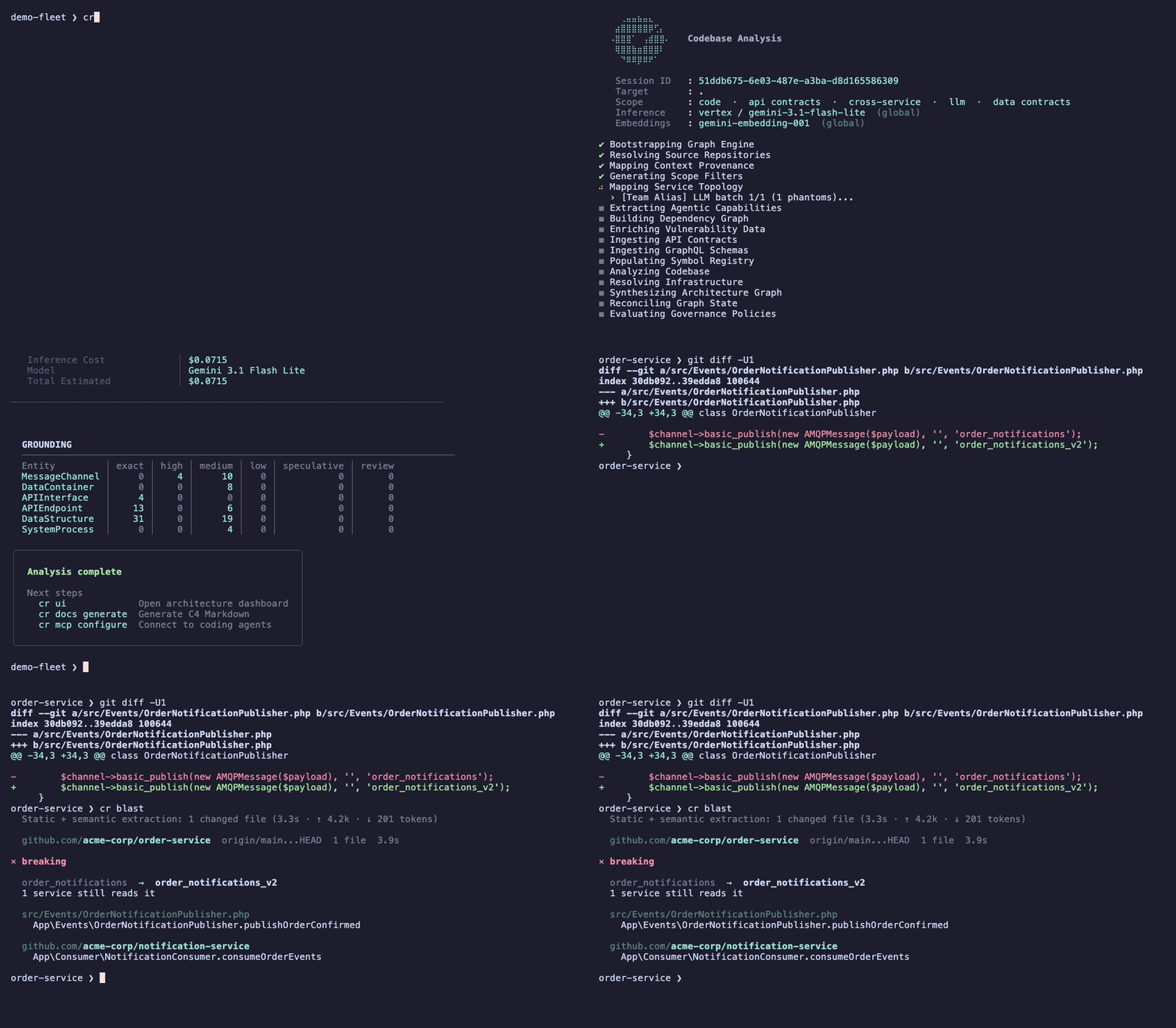
An innocent-looking rename in order-service; cr blast finds the consumer it breaks in notification-service, in seconds. Explore the live demo dashboard →
---
Why
AI coding agents are fast but architecturally blind. They will flawlessly refactor an API payload or rename a database field, unaware they just broke a downstream consumer three teams away. Even without AI, undocumented dependencies accumulate until every cross-service change turns into an archaeological dig.
CodeRadius fixes this with three capabilities on one graph:
- Blast radius before merge: cr blast is terraform plan for architecture. It provides an in-memory topological diff of your changes against the graph, returning structured findings in seconds. Semantic exit codes (0 SAFE, 1 WATCH, 2 BREAKING) let CI and agents branch without parsing text.
- Live context for AI agents: A native MCP server lets any agent query data contracts, downstream consumers, and change impact before writing code.
- Governance as code: Declarative YAML policies evaluated against the live architecture graph, not file-level lint: unowned services, deprecated dependencies on exposed APIs, shared-database anti-patterns.
Local-first. Your code never leaves your machine: bring your own LLM key, or run fully local with Ollama. No telemetry. The only other network call is a once-daily version check (CR_NO_UPDATE_CHECK=1 disables it).
---
Project Status
CodeRadius is 0.x and moving fast, released early to gather real-world feedback, not as a finished product.
What you can rely on today: the deterministic core (AST parsing, import and taint analysis, graph building, blast radius) is pinned by 5,400+ unit tests plus a deterministic eval suite, and every framework marked eval-verified in the compatibility matrix is regression-gated by committed fixtures.
What is still settling: LLM semantic extraction quality varies by stack and provider, and the graph schema and CLI surface may change between 0.x releases without migration paths (re-ingesting is the upgrade path).
If it breaks on your codebase, that's exactly the feedback we need. Please open an issue with the cr --version output and the language/framework involved.
---
Quick Start
Requirements: Docker (for the local graph database). The CLI ships as a self-contained binary for macOS and Linux (x64/arm64), nothing else to install.
npm i -g coderadius # or: bun add -g coderadius
or without a package manager:
curl -fsSL https://raw.githubusercontent.com/coderadius-ai/coderadius/main/scripts/install.sh | bash
To run from source instead (contributors; requires Bun ≥ 1.0 and Node.js ≥ 22):
git clone https://github.com/coderadius-ai/coderadius.git
cd coderadius
bun install
bun link        # exposes the cr binary globally (runs from source, no build step)
Then, from the repo you want to analyze:
cr init                              # configure your LLM provider, generate a smart .crignore
cr up                                # start the local graph database (Memgraph via Docker)
cr analyze code .                    # build the graph (default: --depth semantic)

cr analyze code . --depth structure  # AST-only scan, zero LLM calls

cr analyze code . --depth contracts  # full semantic extraction with data contracts
cr blast                             # blast radius of your current changes vs origin/main

cr blast feature/checkout            # blast radius of a branch (shorthand for --head)

cr ui                                # generate the architecture dashboard

cr mcp start                         # MCP server for your IDE agent
Analyze multiple repos into the same graph (cr analyze code ../orders ../payments ../shipping) and blast radius becomes cross-repo.
---
How It Works
Unlike observability tools that rely on runtime traffic, CodeRadius builds its graph statically through a four-stage pipeline:
1. Auto-Discovery: Detects service boundaries, monorepos, and multi-repo architectures from your codebase or Backstage catalogs.
2. Taint Analysis Engine: Tree-sitter AST parsing identifies only the functions that perform external I/O (HTTP calls, DB queries, message broker events). Pure business logic is ignored. The taint engine filters approximately 85% of functions before a single LLM token is spent.
3. Semantic Extraction: Tainted functions are sent to your chosen LLM to extract intents, payloads, and infrastructure dependencies. A Merkle hash cache makes incremental runs take seconds instead of hours.
4. Global Edge Resolution: Matches emergent client calls in Service A to canonical OpenAPI endpoints in Service B, bridging the cross-repo gap.
Every node and edge carries grounding: who produced the fact (AST, LLM, declaration, infra), the supporting evidence, and how much to trust it.
Built on Bun, tree-sitter, Mastra + Vercel AI SDK, and Memgraph.
---
MCP Server
CodeRadius ships a native MCP server that plugs into any MCP-compatible agent (Claude Code, Cursor, Windsurf, Gemini CLI). The agent discovers these tools and checks impact before writing code:
{
  "mcpServers": {
    "coderadius": {
      "command": "cr",
      "args": ["mcp", "start"]
    }
  }
}
| Tool | Purpose for the Agent |
|------|------------------------|
| resolve_service_context | Orient the agent: map a file path, git remote, or repo name to its service, team, and repository. |
| list_services | Inventory all services with owners, languages, and deployment topology. |
| get_service_details | Deep-dive one service: exposed APIs, endpoint counts, deployment units, CI/CD and Docker infrastructure. |
| get_repository_details | Repository posture: services, pipelines, Docker images, tool configurations, build tasks, commit liveness. |
| get_data_contract | Exact schema (fields and types) of a payload, event, or database table, before modifying it. |
| analyze_blast_radius | Upstream producers and downstream consumers of a resource (table, channel, endpoint). |
| evaluate_code_change_impact | Blast radius of a proposed change via in-memory topological diff, before committing. |
| trace_data_lineage | Follow a data field across services, brokers, and APIs. |
| analyze_architecture_gravity | SPOFs, shared-database anti-patterns, and coupling hotspots ranked by score. |
| analyze_agentic_context | AI-tooling adoption per repository: tools, configurations, skills, workflows. |
Full guide: coderadius.ai/docs/guide/mcp-server
---
Current Support
Languages: TypeScript · PHP · Python · Go · Java
Frameworks (eval-verified): NestJS · Express · Fastify · Hono · Koa · Symfony · Laravel · Slim · Spring Boot · JAX-RS
Frameworks (heuristic + LLM): FastAPI · Flask · Django · Gin · Fiber
Protocols & infra: REST · OpenAPI · GraphQL · RabbitMQ · Google Pub/Sub · PostgreSQL · MySQL
CI/CD ingestion: GitHub Actions · GitLab CI
LLM providers: Google Vertex AI · Google Gemini API · OpenAI · Anthropic · Amazon Bedrock · Ollama (fully local, no API key)
---
Beyond the Basics
- Architecture Dashboard: Self-contained HTML report with service inventory, SPOF analysis, governance violations, and dependency health (cr ui).
- Agent Harness: Maps AI tooling adoption across the fleet: maturity levels, context gaps, team coverage.
- Runtime Traces: Overlay Datadog/Jaeger traces (cr analyze traces) on the static graph to validate architecture against reality.
- Living Docs: Auto-generate ARCHITECTURE.md for any service (cr docs generate).
---
Documentation
- User guide: docs/guide/ including introduction, CLI commands, impact evaluation, governance policies, configuration
- Architecture deep-dives: docs/architecture/ covering ingestion pipeline, graph data model, API-endpoint dedup, service topology, grounding contract
---
Roadmap
- Languages: C#, Ruby
- CI/CD config ingestion: Bitbucket Pipelines, Jenkins (running cr blast inside any CI already works today, Bitbucket included; see the compatibility matrix)
---
Contributing
Contributions are welcome. Language plugins, framework signals, and connection extractors are designed as isolated extension points. See CONTRIBUTING.md.
---
License
Sign in to leave a review
Use Google, GitHub, or an email account so ratings stay tied to real people.
No reviews posted yet.





