
Assisted Service MCP Server
About
MCP server for interracting with the OpenShift Assisted Installer API
Details
- Author
- carbonin
- Downloads
- 179
- Categories
- Other
Jump to
- List, create, and manage assisted installer clusters
- Retrieve detailed cluster and infraenv information
- Monitor cluster and host events
- Set cluster VIPs and host roles
- List OpenShift versions and operator bundles
Obtain an OpenShift API token from https://cloud.redhat.com/openshift/token. Start the server using STDIO configuration (e.g., in VSCode) or SSE transport (recommended). Provide the token as the OFFLINE_TOKEN environment variable or as an OCM-Offline-Token request header for SSE.
Assisted Service MCP Server
MCP server for interacting with the OpenShift assisted installer API.
Diagnose cluster failures and find out how to fix them.
Try it out:
1. Clone the repo:
git clone git@github.com:carbonin/assisted-service-mcp.git
2. Get your OpenShift API token from https://cloud.redhat.com/openshift/token
3. The server is started and configured differently depending on what transport you want to use
For STDIO:
In VSCode for example:
   "mcp": {

        "servers": {

            "AssistedService": {

                "command": "uv",

                "args": [

                    "--directory",

                    "/path/to/assisted-service-mcp",

                    "run",

                    "mcp",

                    "run",

                    "/path/to/assisted-service-mcp/server.py"

                ],

                "env": {

                    "OFFLINE_TOKEN": <your token>

                }

            }

        }

    }
For SSE (recommended):
Start the server in a terminal:
OFFLINE_TOKEN=<your token> uv run server.py
Configure the server in the client:
    "assisted-sse": {
      "transport": "sse",
      "url": "http://localhost:8000/sse"
    }
Providing the Offline Token via Request Header
If you do not set the OFFLINE_TOKEN environment variable, you can provide the token as a request header.
When configuring your MCP client, add the OCM-Offline-Token header:
    "assisted-sse": {
      "transport": "sse",
      "url": "http://localhost:8000/sse",
      "headers": {
        "OCM-Offline-Token": "<your token>"
      }
    }
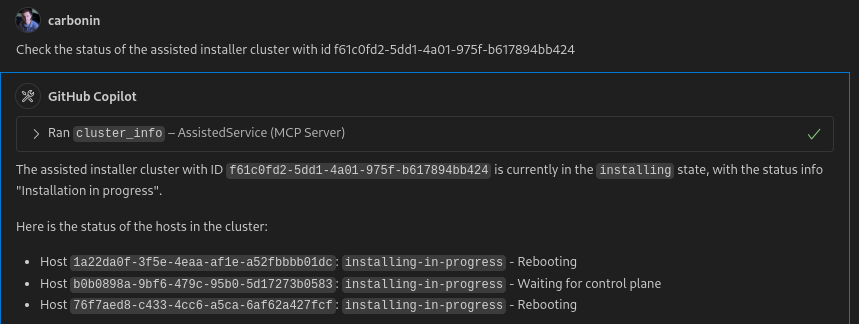
4. Ask about your clusters:
Available Tools
The MCP server provides the following tools for interacting with the OpenShift Assisted Installer:
Cluster Management
list_clusters - Lists all current user assisted installer clusters. Returns minimal cluster information.
cluster_info - Get detailed information about the assisted installer cluster with the given ID
cluster_id: Cluster ID (string, required)
create_cluster - Create a new assisted installer cluster and infraenv. Set single_node to true only for single node clusters or when high availability is not needed. Returns cluster ID and infraenv ID as JSON.
name: Cluster name (string, required)
version: OpenShift version (string, required)
base_domain: Base domain for the cluster (string, required)
single_node: Whether to create a single node cluster (boolean, required)
install_cluster - Trigger installation for the assisted installer cluster with the given ID
cluster_id: Cluster ID (string, required)
set_cluster_vips - Set the API and ingress virtual IP addresses (VIPs) for the cluster
cluster_id: Cluster ID (string, required)
api_vip: API virtual IP address (string, required)
ingress_vip: Ingress virtual IP address (string, required)
Events and Monitoring
cluster_events - Get the events related to a cluster with the given ID
cluster_id: Cluster ID (string, required)
host_events - Get the events related to a specific host within a cluster
cluster_id: Cluster ID (string, required)
host_id: Host ID (string, required)
Infrastructure Environment
infraenv_info - Get detailed information about the assisted installer infra env with the given ID. Contains data like ISO download URL and infra env metadata.
infraenv_id: Infrastructure environment ID (string, required)
Host Management
set_host_role - Update a host to a specific role. Role options are: 'auto-assign', 'master', 'arbiter', 'worker'
host_id: Host ID (string, required)
infraenv_id: Infrastructure environment ID (string, required)
role: Host role (string, required)
OpenShift Versions and Operators
list_versions - Lists the available OpenShift versions for installation with the assisted installer
list_operator_bundles - Lists the operator bundles that can be optionally added to a cluster during installation
add_operator_bundle_to_cluster - Request an operator bundle to be installed with the given cluster
cluster_id: Cluster ID (string, required)
bundle_name: Operator bundle name (string, required)
Usage Examples
List all clusters: "Show me all my clusters"
Get cluster details: "Give me detailed information about cluster abc123"
Create a cluster: "Create a new cluster named 'my-cluster' with OpenShift 4.14 and base domain 'example.com'"
Check cluster events: "What events happened on cluster abc123?"
- Install a cluster: "Start the installation for cluster abc123"
Sign in to leave a review
Use Google, GitHub, or an email account so ratings stay tied to real people.
No reviews posted yet.





